
Key Takeaways
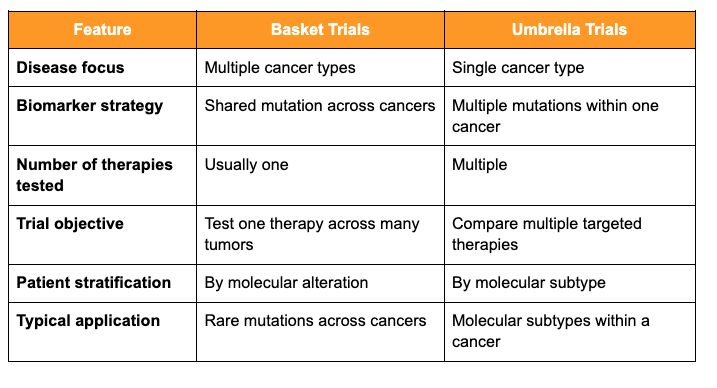
Basket trials investigate whether a targeted therapy is effective across different tumor types that share the same genetic mutation or biomarker.
Umbrella trials evaluate multiple targeted therapies within a single cancer type by stratifying patients based on molecular subtypes.
Both trial designs emerged in response to precision oncology, where treatments are tailored to specific genetic alterations rather than tumor location alone.
Basket trials can accelerate evaluation of therapies targeting rare genomic alterations across multiple cancers.
Umbrella trials allow researchers to explore multiple targeted treatment strategies simultaneously within a single disease.
Why This Comparison Matters Now
The rapid expansion of genomic profiling technologies has transformed cancer research and drug development. Rather than treating cancer solely based on the organ in which it originates, oncologists increasingly classify tumors according to their underlying molecular drivers. Mutations in genes such as EGFR, ALK, BRAF, and others can influence how tumors grow and respond to therapy, regardless of where the cancer arises in the body.
This shift toward molecularly defined cancers has created new challenges for clinical trial design. Traditional randomized controlled trials often enroll large numbers of patients with the same tumor type and evaluate a single therapy against a standard-of-care treatment. However, as cancers become subdivided into increasingly specific molecular subtypes, recruiting sufficient numbers of patients for conventional trials becomes more difficult.
Basket and umbrella trial designs were developed to address this challenge by aligning trial structure with the biology of precision oncology. These approaches allow investigators to evaluate targeted therapies more efficiently by matching patients to treatments based on the genetic features of their tumors.
Both designs are now widely used in oncology drug development and have contributed to several major advances in targeted therapy approvals. Understanding how these trial structures differ is increasingly important as the pharmaceutical industry continues to develop therapies aimed at specific molecular pathways.
 Mechanistic Differences
The fundamental difference between basket and umbrella trials lies in how patients are grouped and how therapies are evaluated.
Basket trials enroll patients who share a common molecular alteration, even if their cancers originate in different organs. For example, a basket trial might evaluate a targeted therapy designed to inhibit a specific oncogenic mutation across patients with lung cancer, colorectal cancer, melanoma, and other tumor types that carry the same genetic change. By focusing on the molecular driver rather than tumor location, researchers can determine whether the therapy is broadly effective against cancers with that mutation.
Umbrella trials take the opposite approach. Instead of enrolling patients with multiple tumor types, umbrella trials focus on a single cancer, such as lung cancer, but divide patients into subgroups based on the molecular characteristics of their tumors. Each subgroup is then assigned to a different targeted therapy designed to address the specific mutation driving that cancer subtype.
Both trial designs rely heavily on genomic testing to identify eligible patients. Molecular diagnostics and next-generation sequencing technologies play a critical role in screening participants and matching them to the appropriate treatment arm.
Manufacturing and Operational Considerations
Although basket and umbrella trials are primarily methodological innovations, they also introduce operational challenges for sponsors and clinical research organizations.
Basket trials often require collaboration across multiple cancer centers because patients with rare mutations may be geographically dispersed. Identifying eligible patients can be difficult, particularly when the targeted mutation occurs infrequently within individual cancer types. Screening large numbers of patients through genomic testing is often necessary to identify suitable participants.
Umbrella trials introduce a different set of logistical complexities. Because multiple therapies are tested simultaneously within a single disease, trial infrastructure must support multiple treatment arms and potentially multiple pharmaceutical partners. Each arm may have its own dosing schedule, monitoring requirements, and regulatory considerations.
Managing these complex trial structures requires robust data infrastructure and careful coordination among investigators, sponsors, and regulators. Advances in digital trial management systems and molecular diagnostic platforms have helped make these innovative designs more feasible.
Best Fit by Use Case
Basket trials are typically preferred when:
a therapy targets a specific genetic mutation that appears across multiple cancers
the mutation is rare within individual tumor types
researchers want to explore whether a targeted therapy works broadly across cancers
Umbrella trials are typically preferred when:
a single cancer type contains multiple molecular subtypes
multiple targeted therapies are available for evaluation
researchers want to match patients to treatments based on tumor-specific biomarkers
Verdict
Basket and umbrella trials represent two complementary approaches to clinical trial design in the era of precision oncology. Basket trials are particularly useful for evaluating targeted therapies aimed at rare genomic alterations that occur across multiple tumor types.
Umbrella trials, by contrast, allow researchers to explore multiple targeted treatment strategies within a single cancer type, reflecting the growing recognition that many cancers consist of several biologically distinct subgroups.
As genomic profiling continues to refine how cancers are classified, both trial designs are likely to play an increasingly important role in accelerating the development of targeted oncology therapies.