

Key Takeaways
Offshoring has historically allowed pharmaceutical companies to reduce costs by concentrating manufacturing in regions with lower labor and production expenses and well-established supply ecosystems.
Reshoring is gaining momentum as governments and regulators push to localize manufacturing of critical medicines and APIs.
Half-shoring — plitting manufacturing between offshore and domestic facilities — has emerged as a pragmatic compromise that balances resilience with cost control.
Many pharmaceutical companies now pursue split-footprint supply chains that keep upstream production overseas while moving downstream activities closer to end markets.
The optimal strategy increasingly depends on risk tolerance, product criticality, regulatory pressures, and capital investment timelines.
Why This Comparison Matters Now
Global pharmaceutical supply chains have been under intense scrutiny in recent years. The COVID-19 pandemic exposed vulnerabilities in highly concentrated manufacturing networks, particularly for active pharmaceutical ingredients (APIs) and essential medicines produced predominantly in Asia. Temporary shutdowns, export restrictions, and logistics disruptions demonstrated how dependent many countries had become on distant suppliers.
These disruptions accelerated discussions about reshoring pharmaceutical manufacturing. Governments in the United States, Europe, and Japan have introduced policy incentives and regulatory initiatives designed to encourage domestic production of critical medicines. National security considerations have also entered the conversation, particularly for drugs considered essential to public health preparedness.
At the same time, fully reshoring pharmaceutical production is not straightforward. Building new manufacturing facilities requires large capital investments and long development timelines. Facilities must be constructed, validated, inspected by regulators, and integrated into existing supply chains. In many cases, the cost advantages of established manufacturing hubs in India and China remain difficult to replicate elsewhere.
As a result, many pharmaceutical companies are adopting hybrid supply chain strategies. Rather than relocating all manufacturing activities, companies are increasingly distributing production steps across multiple geographic regions. This approach — often referred to informally as “half-shoring” or “split-footprint manufactuirng” — allows companies to maintain cost-efficient upstream production while relocating strategically important steps closer to the markets where medicines are ultimately sold.
This shift toward geographically diversified manufacturing networks is reshaping how pharmaceutical companies think about supply chain resilience, regulatory compliance, and long-term manufacturing strategy.
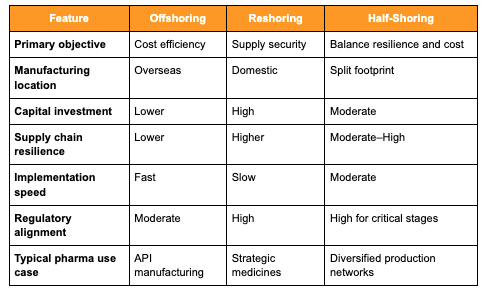 Mechanistic Differences
Offshoring involves relocating manufacturing activities to foreign countries, often to take advantage of lower production costs, specialized labor pools, or established pharmaceutical manufacturing clusters. Over the past several decades, many pharmaceutical companies have offshored large portions of their supply chains, particularly for API synthesis and early-stage chemical intermediates.
Reshoring represents the reverse process. In reshoring strategies, companies relocate manufacturing activities back to their home country or primary market. Governments frequently support these initiatives through subsidies, tax incentives, or regulatory frameworks designed to strengthen domestic manufacturing capacity.
Half-shoring occupies the middle ground between these two approaches. In this model, pharmaceutical companies deliberately distribute different stages of production across multiple regions. Cost-sensitive upstream steps remain offshore, while critical downstream activities, such as drug product manufacturing or fill-finish, are relocated closer to end markets.
This split-footprint approach allows companies to diversify supply risk without fully abandoning the cost efficiencies associated with global manufacturing networks.
Manufacturing and Operational Considerations
Operational realities strongly influence which manufacturing strategy a pharmaceutical company chooses. Offshoring has historically provided substantial cost advantages, particularly for labor-intensive processes such as chemical synthesis or large-scale API production. In addition, regions such as India and China have developed extensive pharmaceutical manufacturing ecosystems that support efficient sourcing of raw materials and intermediates.
Reshoring, however, can improve supply chain visibility and reduce logistical complexity. Domestic manufacturing sites often offer closer proximity to regulatory authorities, better integration with commercial operations, and shorter transportation timelines.
The primary challenge associated with reshoring is the cost and time required to establish new facilities. Pharmaceutical manufacturing plants require years to design, build, validate, and bring into commercial operation. Workforce availability can also be a constraint in regions where pharmaceutical manufacturing expertise is limited.
Half-shoring strategies attempt to balance these operational considerations. By relocating only selected portions of the manufacturing process—such as final API processing, formulation, or packaging—companies can improve supply chain resilience while avoiding the full cost of rebuilding global production networks.
Best Fit by Use Case
Offshoring is typically preferred when:
cost efficiency is the primary objective
manufacturing processes are mature and stable
global supplier ecosystems are well established
production volumes justify large overseas facilities
Reshoring is typically preferred when:
medicines are considered strategically important
regulatory or national security concerns are significant
governments provide incentives for domestic manufacturing
supply chain resilience is the top priority
Half-shoring is typically preferred when:
companies want to diversify supply risk without full relocation
upstream production benefits from global cost advantages
downstream activities require closer proximity to end markets
capital constraints limit large-scale reshoring investments
Verdict
Offshoring once dominated pharmaceutical manufacturing strategy because it provided clear cost advantages and access to large, specialized production hubs. In today’s environment, however, supply chain resilience and geopolitical considerations have become equally important.
While reshoring offers the strongest supply security, the costs and logistical challenges associated with relocating entire production networks make full reshoring impractical for many companies.
As a result, half-shoring — splitting manufacturing across domestic and overseas facilities — is increasingly emerging as a pragmatic compromise. By maintaining global cost efficiencies while relocating critical stages closer to end markets, pharmaceutical companies can build more resilient supply chains without abandoning the benefits of international manufacturing ecosystems.