
Key Takeaways
Traditional randomized controlled trials (RCTs) use fixed protocols and remain the regulatory gold standard for demonstrating safety and efficacy.
Adaptive clinical trials allow preplanned adjustments to aspects of the trial—such as sample size, dosing arms, or patient allocation—based on interim data.
Adaptive designs can accelerate development timelines and reduce exposure to ineffective treatments.
Traditional RCTs offer simplicity, statistical clarity, and regulatory familiarity.
Adaptive designs are increasingly used in oncology, rare disease research, and precision medicine, where flexible trial structures can improve efficiency.
Why This Comparison Matters Now
Clinical trial design is undergoing significant transformation as the pharmaceutical industry seeks to improve development efficiency and reduce the time required to bring new therapies to market. Traditional randomized controlled trials have long been regarded as the most reliable method for evaluating therapeutic interventions. These studies typically involve randomly assigning patients to treatment or control groups and following a fixed study protocol until the trial concludes.
The strength of this model lies in its statistical rigor and methodological clarity. By maintaining a fixed study design and minimizing changes during the trial, traditional RCTs reduce the risk of bias and ensure that treatment effects can be interpreted with confidence. For this reason, regulators have historically relied on RCTs as the primary evidence base for drug approval.
However, the traditional model can also be slow and resource-intensive. If early data suggest that a treatment is ineffective or that one dose is clearly superior to others, traditional trial designs often require the study to continue unchanged until the predetermined endpoint is reached. This can expose patients to ineffective therapies and delay important development decisions.
Adaptive clinical trials were developed to address these limitations. In adaptive designs, researchers plan in advance for certain trial modifications that may occur based on interim analyses of accumulating data. These modifications can include adjusting the sample size, reallocating patients toward more promising treatment arms, dropping ineffective doses, or even stopping the trial early for success or futility.
Advances in statistical modeling, data monitoring technologies, and regulatory guidance have made adaptive trials increasingly feasible. As drug development shifts toward more targeted therapies and smaller patient populations, particularly in oncology and rare diseases, adaptive trial designs are becoming an important tool for improving development efficiency.
 Mechanistic Differences
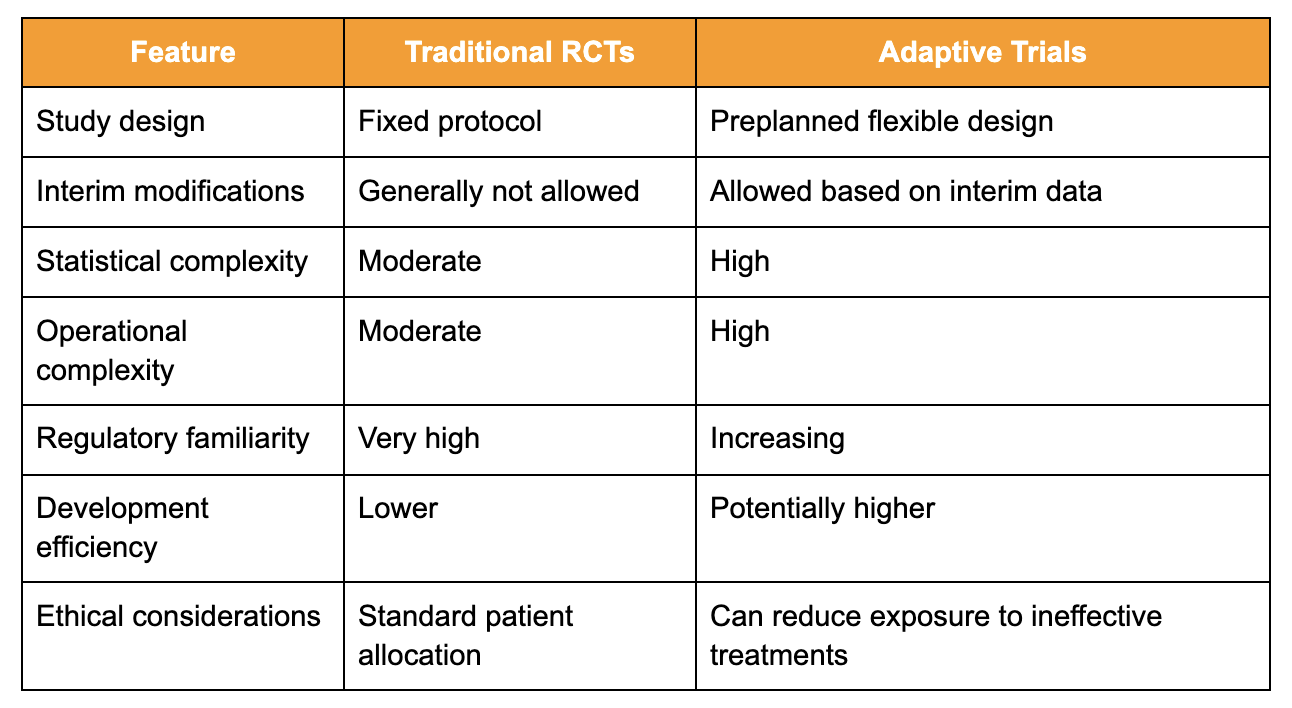
Traditional randomized controlled trials follow a predefined protocol that remains unchanged throughout the study. Key aspects of the trial—such as treatment arms, sample size, dosing regimens, and statistical analysis plans—are established before patient enrollment begins and typically remain fixed until the study concludes. This rigidity helps preserve the statistical validity of the trial by preventing modifications that could introduce bias.
Adaptive trials, by contrast, incorporate statistical frameworks that allow for certain changes during the study while maintaining overall statistical integrity. These changes are not made arbitrarily; rather, they must be predefined in the trial protocol and implemented according to strict statistical rules.
Several types of adaptive designs are commonly used in modern clinical research. For example, adaptive dose-finding studies may adjust dose levels as data emerge about safety and efficacy. Sample size re-estimation designs allow investigators to increase or decrease enrollment based on interim estimates of treatment effect. Response-adaptive randomization can allocate more patients to treatment arms that appear to be performing better as the trial progresses.
These approaches rely heavily on advanced statistical modeling and frequent interim analyses conducted by independent data monitoring committees to ensure that modifications do not compromise the validity of the study.
Operational Considerations
Although clinical trial design primarily concerns statistical methodology, it also has important operational implications for sponsors, contract research organizations (CROs), and clinical investigators.
Traditional RCTs are generally easier to manage operationally because the trial protocol remains stable throughout the study. Investigators and study sites follow a consistent plan for patient enrollment, treatment administration, and data collection. This stability simplifies logistics and reduces the risk of operational errors.
Adaptive trials introduce additional complexity. Interim analyses must be conducted at predefined points during the trial, often requiring rapid data cleaning, statistical evaluation, and coordination among sponsors, statisticians, and regulatory authorities. Changes to trial parameters—such as adjusting enrollment targets or discontinuing treatment arms—must also be communicated to study sites in real time.
These requirements can increase operational demands, particularly for global trials involving many sites and regulatory jurisdictions. However, advances in clinical trial management systems, electronic data capture, and centralized monitoring tools have made adaptive designs increasingly practical to implement.
Best Fit by Use Case
Traditional RCTs are typically preferred when:
regulatory clarity and statistical simplicity are priorities
large patient populations are available for enrollment
the treatment effect is expected to be modest and requires large studies to detect
trial protocols benefit from a stable and predictable structure
Adaptive trials are typically preferred when:
patient populations are small or difficult to recruit, such as in rare diseases
multiple doses or treatment strategies must be evaluated efficiently
early data could inform better patient allocation or study design adjustments
development timelines must be accelerated
Verdict
Traditional RCTs remain the foundation of clinical evidence generation and continue to serve as the primary method for demonstrating drug safety and efficacy to regulators. Their simplicity and statistical transparency have made them the standard for decades of pharmaceutical development.
Adaptive trial designs, however, are becoming increasingly important as the industry seeks to improve efficiency and reduce development timelines. By allowing preplanned adjustments based on interim data, adaptive trials can improve decision-making, reduce exposure to ineffective treatments, and potentially accelerate the evaluation of promising therapies.
Rather than replacing traditional RCTs, adaptive designs are expanding the toolkit available to clinical researchers. Sponsors increasingly view adaptive trials as a complementary strategy that can be used when flexibility and efficiency are particularly valuable.