Key Takeaways
Biocatalysis creates manufacturing value when it provides a meaningful technical and economic advantage over the best practical chemical process.
Kaneka evaluates the molecule, existing chemistry, process requirements, and potential manufacturing benefits before committing to enzyme development.
A manufacturing catalyst must deliver sufficient activity, selectivity, stability, substrate tolerance, and productivity under realistic process conditions.
Kaneka applies enzyme screening and Smart Library engineering to develop promising catalysts toward the performance required for manufacturing.
The strongest process may combine biocatalysis with conventional chemistry, using each approach where it creates the greatest value across the complete synthetic sequence.
Start With the Manufacturing Problem
Biocatalysis can offer an attractive solution to difficult synthetic challenges, but the value of an enzymatic transformation depends on what it changes in the manufacturing process.
A pharmaceutical company may be dealing with limited stereoselectivity, inefficient resolution, preparative chiral chromatography, repeated purification, excessive material use, or a multistep sequence required to produce the desired stereoisomer. For the right molecule, a selective enzymatic transformation can reduce those burdens by providing a more direct route to the target compound.
Kaneka begins by considering the existing process and the problem that needs to be solved. The key question is whether biocatalysis has a realistic opportunity to improve the technical and economic performance of the route enough to justify development.
Determine Whether Biocatalysis Can Beat the Chemical Benchmark
Kaneka considers the substrate, desired transformation, existing chemistry, and relevant stability characteristics, including stability under aqueous conditions. For chiral compounds, the ability to form the desired stereoisomer directly can create a particularly strong opportunity by reducing the amount of material lost to resolution or subsequent separation.
Kaneka's biocatalysis capabilities extend across a range of stereochemically demanding applications, including routes to chiral alcohols, chiral amines, unnatural amino acids, 3-substituted amino acids, and quaternary amino acids, as well as selective C=C reduction.
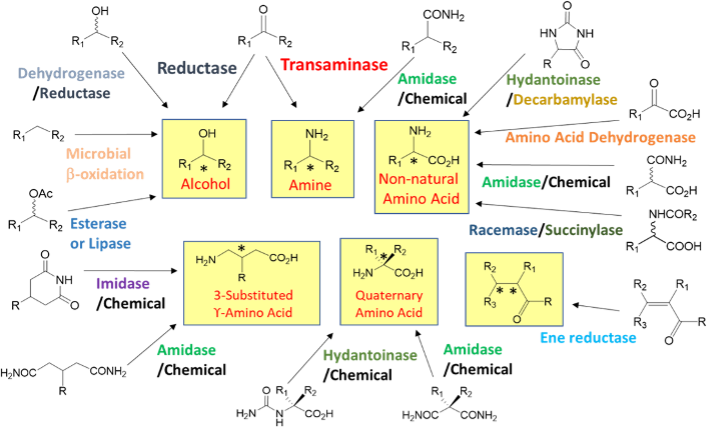 This comparison provides the basis for deciding whether enzyme screening is justified. Some programs may stop at this stage or after early feasibility work if the chemical benchmark remains more attractive overall.
If the potential technical and economic advantage is sufficient, Kaneka can move into enzyme screening to identify a practical starting point.
From Enzyme Screening to a Manufacturing Catalyst
Kaneka screens wild-type enzymes against the customer's substrate to identify catalysts capable of performing the required transformation with useful conversion and selectivity and evaluates properties including activity, selectivity, stability, and substrate tolerance. Activity influences how effectively the transformation can proceed at practical catalyst loading. Selectivity determines whether the desired product can be formed while minimizing unwanted stereoisomers or other reaction products. Stability affects whether the catalyst retains performance throughout the reaction. Substrate tolerance becomes increasingly important as concentration moves toward manufacturing conditions.
Reaction concentration can be decisive. An enzyme may perform well at low substrate concentration yet fail to provide a practical process if productivity declines as concentration increases. Kaneka therefore considers whether the reaction can operate at a substrate concentration that supports commercially relevant productivity rather than relying on activity demonstrated under screening conditions alone.
The downstream process must also remain practical. Kaneka develops the enzymatic reaction together with the workup needed to remove enzyme-related material where relevant, isolate the product reproducibly, and prepare the intermediate for subsequent operations. Improvements in selectivity or route length provide limited benefit if the enzymatic step creates a new bottleneck in workup or isolation. Catalyst development and process development therefore have to progress toward the same manufacturing objective.
Immobilization can also be evaluated when it addresses a specific process need. Depending on the application, it may simplify enzyme removal or improve economics when catalyst reuse is practical, but Kaneka does not treat immobilization as a default requirement for enzymatic manufacturing.
Engineer the Properties the Process Requires
When a wild-type enzyme provides a promising starting point but does not yet meet process requirements, Kaneka can apply its Smart Library approach to improve the properties that matter most.
Structural analysis and homology modeling can help identify positions within the enzyme that may influence performance. Kaneka can then investigate potential hotspots through approaches including saturation mutagenesis and combine favorable mutations where appropriate.
Kaneka can also draw on accumulated knowledge from previous enzyme-development programs when planning an engineering campaign. Prior mutation experience can help identify regions of an enzyme that are more promising targets for modification, allowing development to focus more quickly on changes likely to improve the properties required for the intended process.
The engineering target depends on the process. One catalyst may need greater activity, another improved selectivity or stability, and another better performance at higher substrate concentration.
Kaneka focuses that work on the properties that determine whether the enzyme can support the intended manufacturing process. The expected process advantage and program timeline also influence whether additional engineering is justified.
Replacing a Multistep Chiral-Amine Route with One Enzymatic Transformation
A representative Kaneka project illustrates how that development approach can reshape a process. The existing synthesis used a multistep chemical sequence to produce a chiral amine. Kaneka developed an enzymatic transamination that converted the corresponding ketone directly to the desired chiral amine. The enzymatic reaction replaced the multistep chemical approach with a single biocatalytic transformation, shortening the synthetic sequence and improving overall process efficiency.
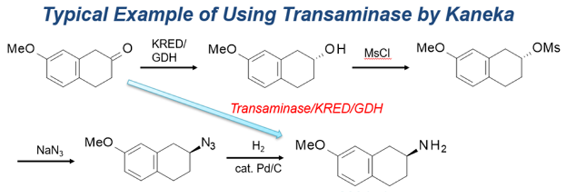 The value extended beyond successfully performing the reaction with an enzyme. Changing how the chiral amine was produced simplified the broader process rather than simply substituting one reaction mechanism for another.
Know When the Chemical Process Is Still Stronger
Kaneka may identify enzymatic activity during screening and still determine that the best practical chemical alternative remains more attractive. Limitations in productivity, development timing, or overall process economics may outweigh the potential benefits of the enzymatic route.
Kaneka therefore continues to compare the enzymatic option with the chemical benchmark as development progresses. Further engineering makes sense when there is a realistic path to a manufacturing advantage substantial enough to justify the additional work.
Integrate the Enzymatic Step into the Complete Route
When biocatalysis is the stronger solution for a transformation, it still must function within the chemistry that surrounds it.
Kaneka's biocatalysis and process-chemistry expertise can be applied together so that the enzymatic step is evaluated as part of the complete synthetic sequence. Hybrid routes are common because different transformations may favor different approaches.
An enzymatic reaction may provide the strongest solution where stereoselectivity is critical, while conventional chemistry remains the better choice for preceding or subsequent steps. The objective is to use each approach where it contributes the greatest value to overall process performance.
Changing one transformation can also affect the rest of the sequence. Improved selectivity may reduce downstream purification. Eliminating several chemical operations can shorten the route. A different intermediate profile may alter isolation or subsequent processing requirements.
Kaneka therefore considers the complete sequence when determining whether an enzymatic transformation has produced a better manufacturing process.
From Biocatalysis Opportunity to Manufacturing Execution
Kaneka can support the progression from initial technical assessment through enzyme screening, enzyme engineering, process development, scale-up, and good manufacturing practice and commercial manufacturing of active pharmaceutical ingredients and intermediates.
The starting point can vary with the customer. An emerging developer may need support from transformation development through GMP API production, while an established program may already have a functioning route and be evaluating biocatalysis to reduce cost, remove a throughput constraint, improve an intermediate process, or support larger-scale manufacturing. Kaneka can tailor the scope of development to the point at which the process currently stands.
For companies that need Kaneka to develop the enzymatic solution, the process begins with a practical question: can biocatalysis improve the current manufacturing strategy enough to justify pursuing it?
Where the answer is yes, Kaneka can develop the catalyst and process to meet the properties and performance requirements that matter for manufacturing. Where the chemical benchmark remains stronger, the evaluation can stop before unnecessary development resources are committed.
If a difficult selective transformation, resolution, preparative chiral chromatography operation, or purification burden is limiting a process, Kaneka can evaluate whether biocatalysis provides a realistic technical and economic route to more efficient manufacturing.