

Alzheimer’s disease and related dementias (ADRD) are reshaping the landscape of long-term care, with prevalence rising and new therapies offering unprecedented potential. Yet despite this urgency, real-world evidence shows that many residents remain untreated or rely primarily on behavioral symptom management. Drawing on de-identified electronic health records from more than 350,000 residents, PointClickCare Life Sciences has revealed systemic treatment gaps shaped by payer structures, facility quality, and geography as much as by clinical need. These findings highlight the risks of leaving long-term care unprepared for disease-modifying therapies, which could widen existing inequities rather than close them. By leveraging real-world data, PointClickCare Life Sciences is helping stakeholders identify barriers, guide practice, and prepare systems to ensure innovation reaches the residents who need it most.
Introduction
Alzheimer’s disease and related dementias (ADRD) represent one of the most pressing health challenges of our time. More than seven million Americans currently live with ADRD, and that number is projected to nearly double by 2050.1 This burden falls especially heavily on long-term care (LTC) settings, where prevalence is high and resources often strained. Studies consistently show that residents with ADRD have more complex medical needs, higher rates of hospitalization, and greater care costs than other nursing home populations.2,3
Despite this growing burden, many LTC facilities remain ill-equipped to deliver specialized dementia care. Research indicates that the number of residents with ADRD is rising rapidly, yet many facilities lack dementia-specific units or sufficient staff trained in cognitive disorders.3 Documentation challenges further complicate care continuity: ADRD is frequently under-recognized in hospital discharge records, and residents are often transferred to lower-quality skilled nursing facilities with limited staffing capacity.4 Together, these systemic weaknesses reinforce longstanding inequities in access, diagnosis, and outcomes.
Against this backdrop, PointClickCare Life Sciences conducted a national real-world analysis of prescribing patterns for ADRD in LTC, using de-identified electronic health record (EHR) data from a large resident population. The findings highlight a consistent pattern of under-treatment and wide variation in prescribing approaches. A substantial proportion of residents with an ADRD diagnosis did not receive guideline-directed pharmacologic therapy, and among those who were treated, behavioral symptom management was far more common than cognitive symptom treatment. Use of disease-modifying therapies remained extremely limited.
These patterns echo long-standing concerns in the literature and raise new questions about the industry’s preparedness for emerging therapies.5,6 Why do so many residents remain untreated despite established guideline recommendations? Which demographic, clinical, and systemic factors influence prescribing decisions? And how can the introduction of innovative therapies avoid widening existing gaps between clinical need and real-world practice?
As the LTC population continues to grow, understanding real-world prescribing patterns is essential, not only for improving day-to-day patient care but also for informing policy, payer strategy, and future clinical guidelines. Consultant pharmacists, clinicians, and life sciences organizations all play critical roles in bridging these gaps and preparing LTC systems for the next generation of ADRD treatments.
Evidence of Treatment Gaps
The PointClickCare Life Sciences analysis revealed a striking and consistent theme: under-treatment remains common in long-term care, and prescribing practices often diverge from clinical guidelines. Within the large national cohort of LTC residents with an ADRD diagnosis, a substantial proportion did not receive guideline-directed pharmacologic therapy. Among residents who were treated, prescribing patterns varied widely, reflecting the influence of diagnosis subtype, comorbidities, age, race, region, and other demographic factors — trends consistent with the broader literature.
Among those who did receive pharmacologic treatment, real-world patterns showed a strong emphasis on behavioral symptom management rather than therapies aimed at cognitive decline or disease progression. Behavioral treatments, such as selective serotonin reuptake inhibitors (29.6% of those treated), atypical antipsychotics (22.6% of those treated), and benzodiazepines (21.2% of those treated), were used as commonly as cognitive symptom treatments, such as acetylcholinesterase inhibitors (25.4% of those treated) or NMDA receptor antagonists (18.6% of those treated).7 Use of disease-modifying therapies remained extremely limited (<0.01% of those treated),7 reflecting both clinical hesitancies and the operational challenges of introducing complex treatments into LTC settings.
This pattern of undertreatment is not new. Earlier studies of U.S. nursing homes found that only about 30% of newly admitted residents with mild-to-moderate Alzheimer’s disease received donepezil, despite clear clinical eligibility.5 More recent work has shown a decline in antidementia medication use in nursing home residents over the last decade, particularly following LTC admission.6 These long-term trends underscore how deeply entrenched treatment gaps are and why even major therapeutic advances may fail to reach residents without meaningful systemic change.
Taken together, these findings illustrate an urgent issue: while behavioral symptom management is essential in LTC populations with complex needs, overreliance on behavioral treatments risks leaving cognitive symptoms undertreated. The limited uptake of guideline-directed cognitive therapies and emerging disease-modifying options reflects ongoing concerns about polypharmacy, uncertain effectiveness in frail populations, drug–drug interactions, and operational burdens on facilities. Without targeted interventions, these obstacles may hinder the equitable adoption of future therapies and widen existing disparities in dementia care.
PointClickCare Life Sciences
PointClickCare Life Sciences is the research arm of PointClickCare, drawing on de-identified electronic health record (EHR) data from thousands of LTC and post-acute care (LTPAC) facilities across North America. Covering more than 70% of U.S. skilled nursing facilities, the platform provides a uniquely longitudinal view of resident health, tracking diagnoses, prescriptions, comorbidities, assessments, and daily observations over time. This scale and richness make it the largest and most detailed data set of its kind, updated frequently to reflect near real-time care patterns while maintaining patient privacy.
The Life Sciences business unit leverages this data set to help companies, policymakers, and researchers ask novel questions that traditional trials and claims data cannot answer. By illuminating real-world treatment patterns, disparities, and outcomes in vulnerable populations, the data supports clinical trial design, health economics research, post-market surveillance, and market strategy. It also enables stakeholders to uncover systemic barriers, such as payer structures or facility quality, that shape care delivery. In doing so, PointClickCare Life Sciences bridges the gap between innovation and practice, ensuring that therapies developed for older adults can truly reach those who need them most. For dementia care, this means identifying real-world prescribing gaps and supporting the equitable adoption of disease-modifying therapies.
What the Data Reveal About Barriers
Understanding not only how often residents are treated but also which factors predict treatment or exclusion is essential to uncovering the systemic barriers that perpetuate these gaps. The PointClickCare Life Sciences analysis did more than describe treatment rates; it clarified the demographic and clinical factors that influence prescribing decisions in LTC settings. These patterns illuminate the structural forces that can prevent residents from receiving timely and appropriate ADRD care.
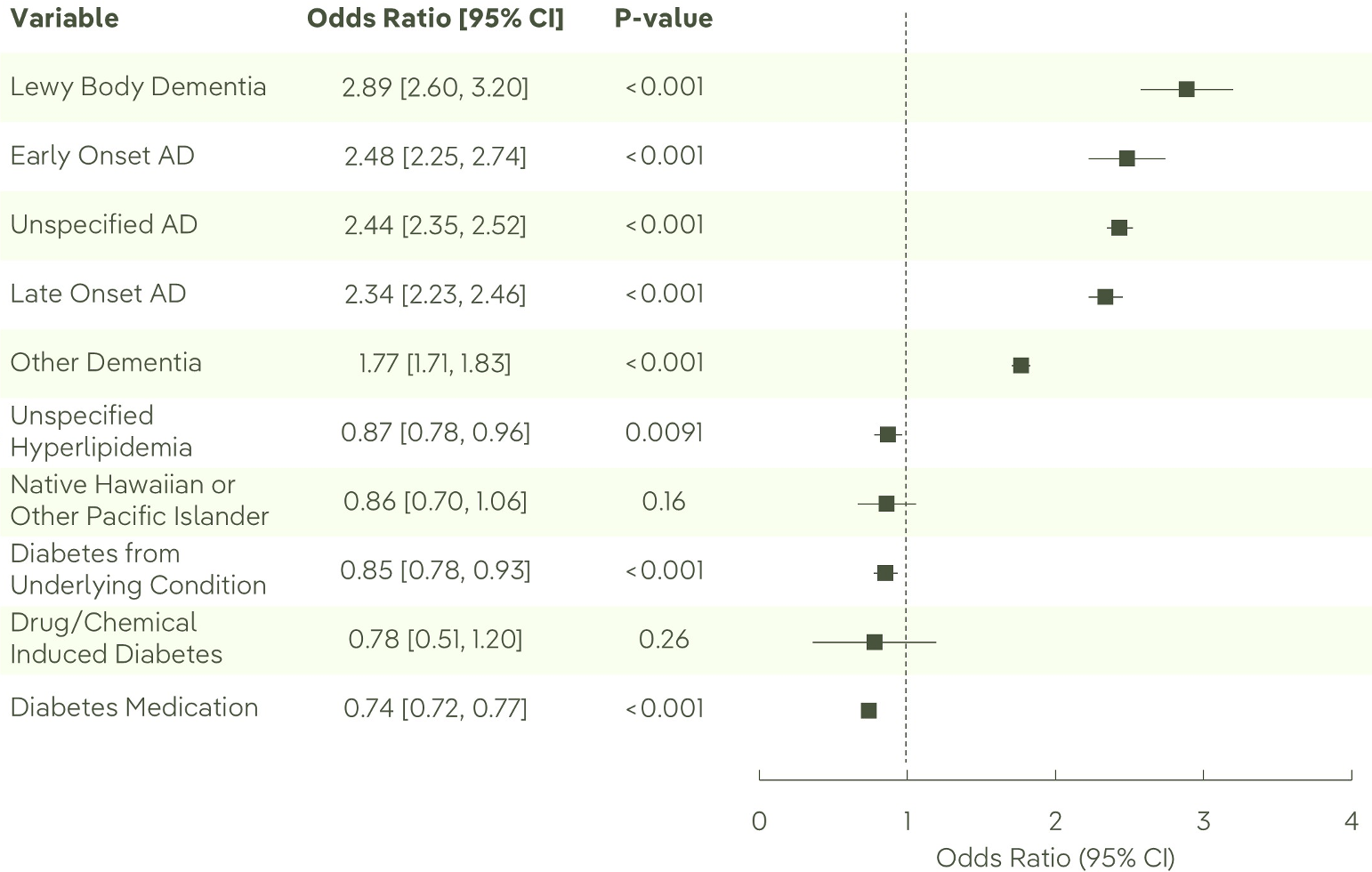 Figure 1. This figure highlights the variables with the five highest and five lowest odds of receiving ADRD treatment. Symbols to the right of the dotted line represent increased odds of treatment and symbols to the left of the dotted line represent decreased odds of treatment. Abbreviations: AD=Alzheimer’s disease; CI=confidence interval
The analysis showed that treatment decisions vary meaningfully by age, comorbidities, diagnosis subtype, race, and geographic region, reflecting trends also observed in the published literature. Residents with certain ADRD subtypes, such as Alzheimer’s disease or Lewy body dementia, were more likely to receive guideline-directed pharmacologic therapy, while those with substantial comorbidities or certain prescription medications (e.g., diabetes medication) were less likely to be treated (Figure 1).7 Demographic factors, including race and region, also contributed to variation, suggesting that practice norms and access constraints continue to shape care delivery across the LTC landscape. These findings reinforce the central insight of research: prescribing decisions are influenced by a complex interplay of clinical, demographic, and contextual variables, rather than diagnosis alone.
Importantly, these trends mirror broader evidence. Studies show that racial and ethnic minority residents are less likely to receive ADRD diagnoses or guideline-concordant treatments.2 Facility-level factors also matter: residents with ADRD are often discharged into lower-quality nursing facilities with limited staffing or specialized dementia expertise, reducing the likelihood that they will receive appropriate therapy.5 Additional research has documented regional variation and differences by facility ownership models, highlighting systemic inequities that extend well beyond individual prescribers.3
Perhaps most concerning, prescribing in LTC often appears reactive rather than tailored to disease subtype or stage. Decisions may be driven by concerns about competing comorbidities, drug interactions, or reimbursement rules, as well as local prescribing culture. This reactive approach has significant consequences: residents with ADRD risk being treated as a homogeneous group despite substantial variation in diagnosis, progression, and therapeutic need. Without deliberate efforts to align practice with evidence-based guidance, these disparities may persist, and potentially widen, as new therapies emerge.
Why This Matters for Innovation and Equity
The implications of these findings extend well beyond the current treatment landscape. As disease-modifying therapies for ADRD continue to emerge, there is a real risk that LTC residents — the population most profoundly affected by dementia — may not benefit equitably from innovation. Real-world prescribing patterns show limited uptake of newer therapies and continued reliance on behavioral symptom management, highlighting how systemic barriers could magnify disparities as treatment options evolve. Recent research has reinforced this concern, documenting declines in antidementia medication use among nursing home residents between 2011 and 2018, particularly following LTC admission.7
Two dimensions of this challenge are especially concerning. The first is equity. Residents who remain untreated in real-world practice tend to be older, have multiple comorbidities, and reside in regions where guideline-directed care is less consistently adopted, patterns mirrored in the published literature. Studies show that racial and ethnic minority residents and those living in lower-quality facilities are less likely to receive guideline-concordant dementia care.2,4 At the same time, the number of nursing home residents with ADRD continues to rise, yet many facilities lack specialized units, trained staff, or the infrastructure necessary to provide comprehensive dementia care.4 Without deliberate, targeted interventions, these disparities risk widening as more complex and resource-intensive therapies become available.
The second dimension is innovation readiness. Introducing novel ADRD therapies into LTC requires more than regulatory approval; it demands changes in clinical workflows, staff expertise, diagnostic practices, and prescribing culture. The COVID-19 pandemic made these vulnerabilities clear. Nursing homes already operating under strain faced severe staffing shortages, reduced physician access, and heightened infection-control demands, all of which disrupted routine care and worsened outcomes for residents with dementia. These stresses underscored how fragile LTC systems can be and why preparing them for the integration of disease-modifying therapies is both urgent and complex.
Ultimately, this is not just a question of access to medications. It is a question of ensuring that innovation in ADRD therapeutics translates into meaningful, real-world benefit for residents in LTC. Meeting this moment requires confronting structural inequities now, before the next generation of treatments risks deepening existing gaps in dementia care.
The Path Forward
If LTC is to keep pace with the rapid evolution of ADRD treatment, the industry must address the barriers surfaced through real-world evidence. Meaningful progress will require coordinated action across clinical practice, facility operations, and policy environments.
First, prescribing practices must evolve from reactive, symptom-driven approaches to more proactive, diagnosis-specific strategies. Consultant pharmacists, physicians, and interdisciplinary care teams are central to this shift. By using real-world evidence to monitor prescribing patterns, anticipate barriers, and reinforce guideline-concordant care, they can help ensure that treatment decisions reflect both established guidance and emerging therapeutic options. Their efforts, however, must be supported by facility leadership, payers, and regulators who can align incentives, educational efforts, and operational workflows around appropriate ADRD management.
Second, payers and policymakers play a critical role in reducing structural inequities. The influence of factors such as comorbidities, demographics, and regional practice norms underscores the need for reimbursement models and policy frameworks that support equitable adoption of ADRD therapies. Without such alignment, even highly effective new drugs may remain inaccessible to large segments of the LTC population.
Finally, advancing ADRD care in LTC requires a truly data-driven ecosystem. By leveraging de-identified EHR data at scale, PointClickCare Life Sciences can help stakeholders understand real-world prescribing patterns, identify systemic barriers, and design targeted interventions. This ability to generate timely, practice-informed insights offers a pathway to translate guidelines into consistent, real-world improvements in resident outcomes.
As ADRD prevalence rises and therapeutic innovation accelerates, the challenge is clear: ensuring that innovation leads to equity, not disparity. By illuminating patterns, exposing barriers, and supporting a shared understanding of opportunities, PointClickCare Life Sciences is well positioned to help the industry build a future in which LTC residents benefit fully from advances in dementia care.
Conclusion – A Call to Action
The emergence of new therapies for ARRD represents both a moment of hope and a critical test. Will LTC systems adapt quickly enough to ensure residents benefit from these innovations? Or will systemic barriers, entrenched prescribing patterns, and uneven access leave the most vulnerable behind?
Real-world evidence makes clear that significant treatment gaps persist in LTC. Many residents with ADRD do not receive guideline-directed pharmacologic therapy, and among those who do, treatment often centers on behavioral symptom management rather than cognitive or disease-modifying options. These disparities are longstanding and unlikely to resolve without deliberate, coordinated intervention.
Progress will require collective action. Consultant pharmacists, clinicians, payers, and policymakers must work together to align treatment practices with current guidelines and emerging evidence. Real-world data must serve as the foundation for this transformation, illuminating barriers, guiding interventions, and ensuring accountability across the care continuum.
PointClickCare Life Sciences is committed to supporting this effort. By harnessing the power of de-identified EHR data at scale, we help stakeholders understand prescribing patterns, identify systemic obstacles, and accelerate equitable adoption of innovative therapies in LTC. With shared commitment and data-driven insight, the industry can move toward a future in which all residents benefit from advances in dementia care.
References
1. 2024 Alzheimer’s Disease Facts and Figures. Alzheimer’s Association. 2024.
2. Rivera-Hernandez, Maricruz, et al. “Quality of Care and Outcomes Among a Diverse Group of Long-Term Care Residents With Alzheimer’s Disease and Related Dementias.” Journal of Aging and Health. 34: 283–296 (2022).
3. Mukamel, Dana B, et al. “Dementia Care Is Widespread In US Nursing Homes; Facilities With The Most Dementia Patients May Offer Ways To Better Care.” Health Affairs (Millwood). 42: 795–803 (2024).
4. Boling, Peter A and Christian Bergman. “New Evidence of the Continuing Need to Improve Nursing Facility Care for Patients With Dementia.” JAMA Network Open. 6: e2255141 (2023).
5. Pedone, Claudio, Kate L Lapane, Vince Mor, and Roberto Bernabei. “Donepezil use in US nursing homes.” Aging Clinical and Experimental Research. 16: 60–67 (2004).
6. Ott, BR, et al. “Antidementia medication use in nursing home residents.” Journal of Geriatric Psychiatry and Neurology. 37: 194–205 (2024).
7. Mathers, Kate, et al. “Access to Pharmacologic Treatment for Alzheimer’s Disease and Related Dementias in U.S. Long-Term Care: A Real-World EHR-Based Analysis” [Poster Presentation]. ASCP 2025 Annual Meeting, Atlanta, USA. Poster 28 (2025, Nov 17-20).