
Key Takeaways
Spray-dried dispersions (SDDs) commonly create amorphous solid dispersions in which a poorly soluble API is stabilized within a polymer matrix, enabling supersaturation and potentially substantial improvements in oral exposure.
Nanocrystals improve dissolution primarily by reducing crystalline API particles to the nanoscale, greatly increasing surface area while retaining a high drug loading.
SDDs can be particularly valuable when apparent solubility and maintenance of supersaturation are required, but physical stability and recrystallization must be carefully controlled.
Nanocrystals can provide a relatively formulation-efficient approach with high API content, but particle aggregation, crystal growth, and maintenance of nanoscale dimensions must be managed.
The choice depends on the molecule's solid-state properties, dose, required exposure enhancement, physical stability, formulation burden, and intended dosage form. Both approaches have substantial development experience and commercial precedent.
Why This Comparison Matters Now
Poor aqueous solubility remains one of the most persistent challenges in small molecule drug development. Promising compounds can demonstrate strong biological activity but inadequate exposure because they dissolve too slowly or insufficiently in gastrointestinal fluids. This is particularly relevant for Biopharmaceutics Classification System (BCS) class II compounds, for which permeability may be adequate but dissolution and solubility limit absorption. Both amorphous solid dispersions (ASDs) and nanocrystals have become established strategies for addressing this problem.
Spray-dried dispersions (SDDs) and nanocrystals attack the problem from fundamentally different directions. An SDD generally changes the physical state of the drug. Spray drying can rapidly remove solvent from a drug-polymer solution, trapping the active pharmaceutical ingredient (API) in an amorphous, higher-energy state. Appropriate polymers can then help inhibit crystallization and maintain supersaturation after administration.
Nanocrystals generally leave the API crystalline but make the particles dramatically smaller. Reducing particle dimensions into the nanometer range increases the surface area exposed to dissolution media and can increase dissolution rate; nanosizing can also increase saturation solubility under appropriate conditions.
This makes the comparison especially useful during formulation development. Both technologies can rescue poorly soluble compounds, but they solve different physicochemical problems and create different downstream challenges. Choosing the appropriate strategy early can affect formulation composition, manufacturing process, stability program, dose feasibility, and eventual commercial dosage form.
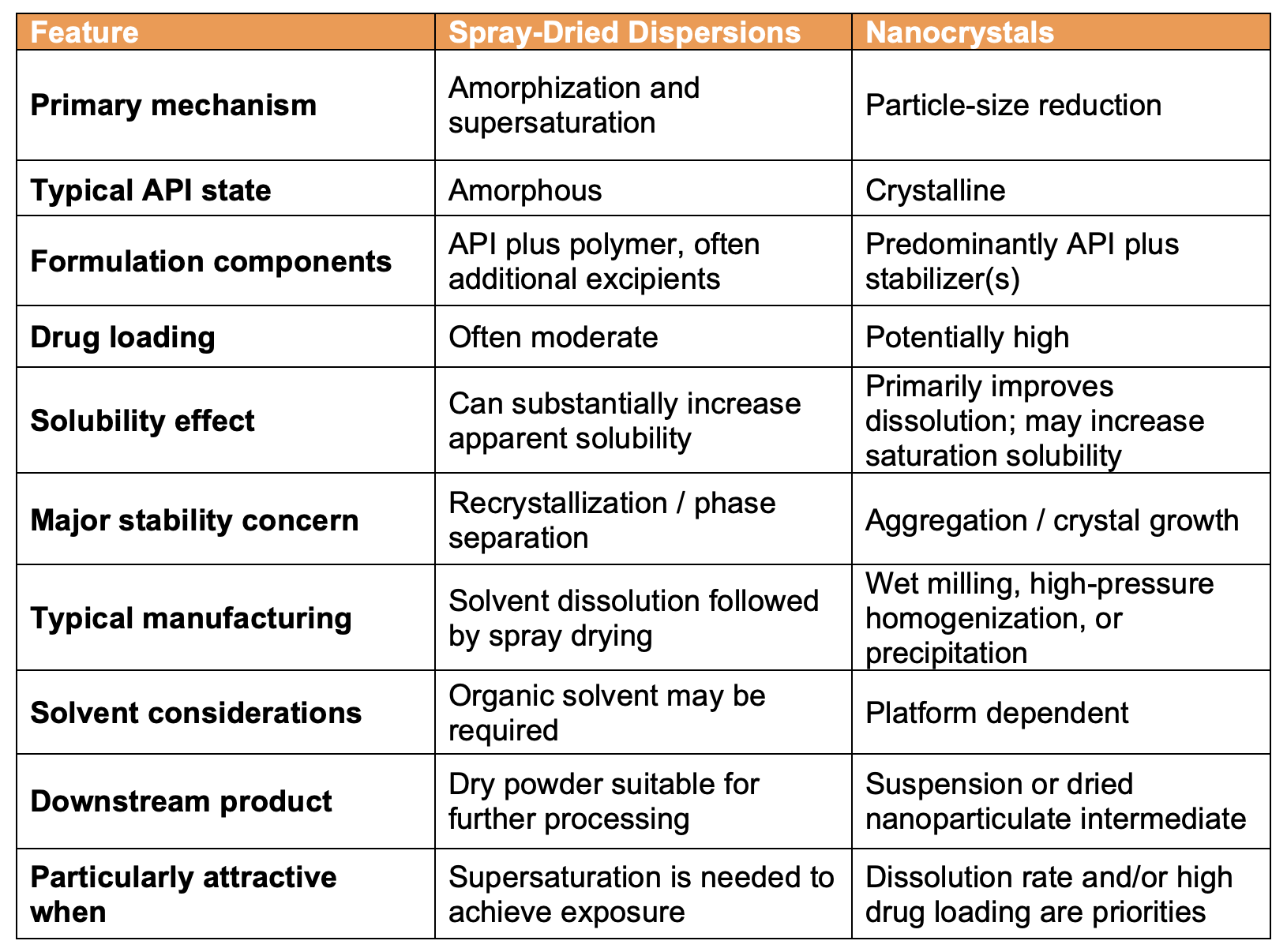 Mechanistic Differences
Spray-dried dispersions generally rely on amorphization. The API and an appropriate polymer are dissolved in a common solvent or solvent system and atomized into a heated drying chamber. Rapid solvent evaporation can prevent the API molecules from reorganizing into an ordered crystal lattice, generating particles in which amorphous drug is dispersed within a polymeric matrix. Feed composition, solvent choice, API–polymer interactions, drying conditions, and other process variables all influence the resulting material.
The amorphous state has higher free energy than the corresponding crystalline form. When the formulation encounters gastrointestinal fluid, this can support concentrations above the drug's equilibrium crystalline solubility. The polymer has an important second function: helping inhibit nucleation and crystal growth so that the supersaturated state persists long enough for absorption.
The same thermodynamic advantage creates SDDs' central challenge. Amorphous drug has a natural tendency to return to the lower-energy crystalline state. Formulators must therefore select polymers and processing conditions that maintain physical stability during manufacturing and storage and control precipitation after administration.
Nanocrystals do not ordinarily require elimination of the crystal lattice. Instead, the formulation reduces API crystals to nanoscale dimensions. The increased surface-area-to-volume ratio allows a much larger drug surface to contact the dissolution medium at once, accelerating dissolution. Particle-size reduction can also alter saturation solubility at sufficiently small dimensions.
That approach avoids the inherent recrystallization risk associated with maintaining an amorphous drug but introduces another stability problem: nanoscale particles have high surface energy and may aggregate or grow. Surfactants or polymeric stabilizers are therefore commonly needed to maintain the desired particle-size distribution.
Manufacturing and Operational Considerations
Spray drying is an established and scalable pharmaceutical manufacturing technology, but SDD development requires close coordination between formulation and process design. Developers must identify a solvent system capable of dissolving the API and polymer at useful concentrations, establish appropriate API–polymer compatibility, and control feed rate, atomization, inlet and outlet conditions, drying kinetics, residual solvent, particle properties, and yield.
Solvent handling can become particularly important at commercial scale. Organic solvents may require explosion-protected equipment, solvent recovery, environmental controls, and residual-solvent testing. The polymer fraction also means that high-dose products can become challenging if the dispersion requires substantial excipient relative to API.
Nanocrystal manufacturing commonly relies on top-down techniques, such as wet media milling or high-pressure homogenization, although bottom-up precipitation and other approaches are also available. Process development focuses heavily on achieving the required particle-size distribution and maintaining it throughout manufacturing, storage, and downstream processing.
One important potential advantage is drug loading. Because the particles themselves are largely crystalline API and comparatively small quantities of stabilizers may be sufficient, nanocrystal formulations can accommodate high API fractions. That can matter when dose size makes a polymer-rich amorphous dispersion impractical.
Nanocrystals also provide dosage-form flexibility. Nanosuspensions can sometimes be administered as liquids or converted into solid intermediates for tablets or capsules. Drying, however, must be engineered so that nanoparticles redisperse appropriately rather than forming irreversible aggregates.
Regulatory and Development Considerations
Neither approach is experimental in the regulatory sense. ASDs and nanocrystal technologies both have substantial scientific literature and commercial-product precedent. The development burden instead centers on demonstrating that the chosen formulation can reproducibly maintain the physical properties responsible for its performance.
For an SDD, that means establishing control over amorphous content, residual crystallinity, drug–polymer interactions, moisture sensitivity, residual solvent, dissolution behavior, and physical stability. Because recrystallization can alter dissolution and bioavailability, solid-state characterization becomes central to the control strategy.
For nanocrystals, particle size and particle-size distribution become particularly important quality attributes. Developers must understand whether processing or storage promotes aggregation, agglomeration, Ostwald ripening, or polymorphic changes and whether downstream manufacturing alters the properties responsible for enhanced dissolution.
Both technologies therefore shift the development problem away from simple API assay and toward a deeper understanding of physical form and formulation performance.
Best Fit by Use Case
Spray-dried dispersions are typically preferred when:
a substantial increase in apparent solubility is needed rather than faster dissolution alone
the molecule can be stabilized successfully in an amorphous polymer matrix
supersaturation can meaningfully increase gastrointestinal exposure
the required polymer loading remains compatible with the target dose and dosage form
the API and polymer can be processed using an acceptable solvent system
formulation development indicates that an amorphous approach provides a clear bioavailability advantage
Nanocrystals are typically preferred when:
slow dissolution is the dominant limitation to absorption
maintaining the crystalline form is advantageous
high drug loading is important, particularly for larger doses
the molecule is difficult to formulate into a stable amorphous dispersion
minimizing the amount of polymer or other formulation excipients is desirable
a nanosuspension or nanoparticle-based solid dosage form fits the intended product profile
Verdict
Spray-dried dispersions and nanocrystals are both established technologies for improving delivery of poorly soluble drugs, but they should not be viewed simply as two manufacturing routes to the same result. They address solubility limitations through fundamentally different physical mechanisms. Amorphous dispersions exploit the energetic advantage of reduced molecular order and supersaturation, while nanocrystals exploit nanoscale particle dimensions while largely preserving crystalline structure.
Spray-dried dispersions generally have the advantage when overcoming the API's equilibrium crystalline solubility is necessary to achieve sufficient exposure. Their ability to create and sustain supersaturation can provide a powerful bioavailability advantage, provided that the amorphous system can be physically stabilized.
Nanocrystals generally have the advantage when dissolution rate is the primary obstacle or when high drug loading is critical. Preserving the crystalline API can reduce some solid-state stability challenges associated with amorphous formulations, although maintaining nanoscale particle size creates a different set of formulation requirements.
The best choice therefore starts with identifying the actual barrier to absorption. If the molecule needs a higher apparent solubility ceiling, an SDD may offer the stronger solution. If sufficient solubility exists but the crystalline drug dissolves too slowly — or formulation size makes a polymer-rich dispersion unattractive — nanocrystals may provide the more efficient path.
For difficult molecules, early parallel screening of both approaches can be especially valuable. The objective is not simply to identify which technology produces the largest improvement in an in vitro dissolution test, but which one can translate that improvement into stable, manufacturable, clinically meaningful exposure at the required dose.