Foundation models (FMs) are redefining biological design by moving beyond static prediction toward intelligent creation. The latest systems no longer just infer protein structures—they integrate text, sequence, and experimental context to reason across biological scales. By embedding design intent directly into generative logic, they merge understanding and invention into a single computational framework. This final article looks ahead to how these models will integrate with regulatory, ethical, and manufacturing systems, ushering in an era of intelligent, auditable, and globally scalable biomanufacturing.
Please also see part 1, which explores how multimodal and controllable architectures are enabling artificial intelligence to design therapeutics tuned not only for function but for manufacturability and experimental realism, and part 2, which examines how process-aware models are embedding manufacturability, stability, and scalability into molecular design and how emerging benchmarks are redefining what it means to validate AI in biomanufacturing.
Translational and Regulatory Outlook
As biological foundation models (FMs) evolve from academic prototypes to engines of molecular innovation, their integration into regulated biopharmaceutical workflows presents both opportunity and challenge. Regulators and industry alike are confronting a future in which therapeutic candidates, analytical methods, and even manufacturing strategies may originate from generative artificial intelligence (AI) systems. To realize this potential responsibly, the field must develop frameworks that ensure transparency, reproducibility, and ethical oversight—criteria as essential to regulatory acceptance as to scientific validity.
Data Provenance and Explainability
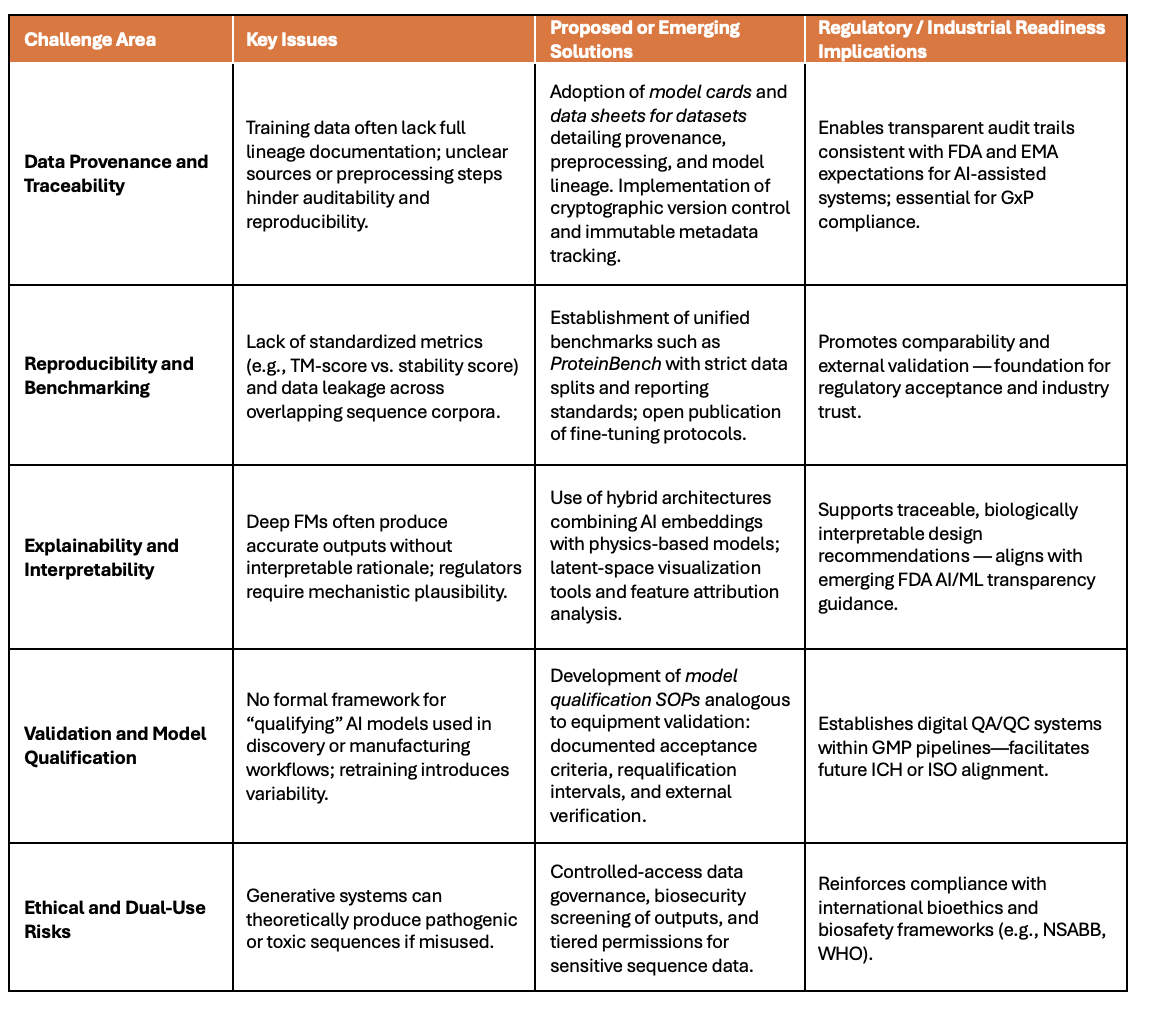
Regulatory agencies, such as the U.S. Food and Drug Administration (FDA) and the European Medicines Agency (EMA) are increasingly emphasizing traceability and explainability in AI-assisted decision-making. For FMs used in therapeutic design, this will require complete documentation of data set provenance, model lineage, and training objectives. Every stage, from pretraining corpus selection to fine-tuning and post hoc evaluation, must be traceable and auditable. The goal is to enable regulators to reconstruct not only what a model predicts but why.1
Emerging best practices point toward the adoption of standardized model cards, analogous to electronic batch records in manufacturing. These cards would detail data sources, preprocessing methods, training epochs, and validation results, forming a digital audit trail for each model instance. When FMs are fine-tuned or adapted to new therapeutic contexts, version control and lineage tracking become mandatory, ensuring that every output can be traced to its model of origin. In practice, this will transform AI systems from opaque research tools into fully documented components of quality systems.
Explainability also intersects with safety and accountability. Regulators will expect clear rationales linking model outputs, such as designed sequences or predicted stability scores, to interpretable biochemical features. This may require hybrid workflows in which AI-driven results are supplemented by biophysical models or empirical validation to demonstrate mechanistic plausibility. In effect, explainability will become a design constraint: models that cannot justify their predictions in terms of known biology are unlikely to gain regulatory acceptance.
Validation and Comparability
As FMs begin to generate candidate molecules, regulators will require new kinds of comparability assessments. AI-generated proteins, RNAs, or other biologics will need to be validated for equivalence to traditional designs in terms of safety, efficacy, and manufacturability. This echoes principles from existing frameworks, such as ICH Q14 (Analytical Procedure Development), which outlines how novel analytical methods must demonstrate consistency, reliability, and control before adoption. Similarly, the FDA’s evolving guidance on AI/machine learning (ML)-based medical tools emphasizes continuous validation, retraining oversight, and risk-based evaluation.
For biologics derived from generative AI, such frameworks imply the creation of model qualification protocols. Before regulatory submission, developers may need to demonstrate that an FM’s predictions or generative outputs have been validated across representative classes of molecules. Batch-to-batch consistency in AI outputs will also need to be controlled, particularly for models that may change through continuous learning. This could involve “locking” model weights after validation, akin to freezing a validated analytical method.
Furthermore, comparability testing must extend to process performance. Regulators will want assurance that AI-designed candidates behave predictably in manufacturing, with yield, stability, and purity remaining within qualified ranges. As computational pipelines move closer to good manufacturing practice (GMP) operations, validation will need to encompass both model behavior and manufacturing outcomes, establishing traceable links between in silico design and in-process verification.2
From Research Models to GMP-Aligned Pipelines
Transitioning from research-grade models to GMP-compliant AI platforms will demand new operational standards. Fine-tuning foundation models on proprietary or confidential data sets introduces intellectual property complexities and validation challenges: once adapted, a model’s outputs are no longer directly comparable to its pretrained baseline, requiring renewed qualification.
To manage this, biopharma organizations will likely adopt standard operating procedures (SOPs) for model qualification — formalized processes verifying that AI systems perform reliably under defined conditions, analogous to equipment or process qualification in GMP manufacturing.3 These SOPs will specify acceptance criteria, testing intervals, retraining conditions, and documentation formats. For high-impact use cases, such as automated therapeutic design or stability prediction, qualification may also require third-party verification or cross-laboratory reproducibility testing.
This emerging discipline, sometimes referred to as GxP-aligned machine learning, will redefine quality assurance in computational biology. Instead of validating only wet-lab processes, organizations will validate the digital workflows that increasingly precede them. Over time, qualified models could become recognized assets, reusable across projects and filings, much like validated analytical methods are today.
Ethical and Safety Considerations
Beyond compliance, biological FMs introduce distinct ethical and biosafety risks. Their capacity to generate new sequences with functional potential raises concerns about dual use — the inadvertent creation of pathogenic or otherwise hazardous molecules. While most current FMs are optimized for therapeutic relevance, their generative flexibility demands controlled-access governance. Data repositories used for training and fine-tuning must be secured, with access contingent on institutional review and use-case vetting.2
Regulators and developers are beginning to address these risks through tiered data governance frameworks. Sensitive biological data sets, such as pathogenic genome sequences or toxin motifs, can be included under restricted access with cryptographic provenance tracking. Similarly, model outputs may be screened against biosecurity databases before release or synthesis. Such safeguards ensure that the benefits of generative biology are realized responsibly, maintaining public trust and compliance with international bioethics standards.
In the longer term, ethical oversight will likely extend beyond safety to include fairness and accessibility. Foundation models trained predominantly on well-characterized, high-resource datasets risk reinforcing global inequities in therapeutic discovery. Expanding training data to include diverse biological and population contexts will be essential for ensuring that AI-designed therapies benefit all patient populations equally.
The regulatory future of biological FMs will depend on establishing transparent, auditable, and ethical frameworks that integrate seamlessly with GMP systems. These models will not replace regulation but redefine its scope, expanding oversight from physical processes to the algorithms that increasingly shape them. If properly governed, FMs could become not only engines of discovery but trusted components of regulated manufacturing, embodying a new standard of quality-by-design for the age of intelligent biomanufacturing.1–3
Table 2. Key Challenges and Emerging Solutions for Industrial Translation of Biological Foundation Models
Future Horizons: The Convergence of AI, Biology, and Process Engineering
The emergence of the biological FMs marks the beginning of a new era in which discovery, development, and manufacturing are no longer discrete phases but components of a single adaptive system. As these models grow more sophisticated, their role will extend beyond molecular design into real-time bioprocess prediction and control, blurring the line between computational biology and bioprocess engineering. The convergence of AI, automation, and digital infrastructure will yield self-learning ecosystems capable of designing, validating, and scaling therapeutics with unprecedented efficiency.
Toward Generalist Biological Models
The current generation of FMs remains specialized: some excel at structure prediction, others at generative design, others still at functional annotation or process forecasting. Yet the trajectory is clear: toward generalist biological models that unify the entire chain of molecular reasoning, from sequence to manufacturability. These models will learn the full hierarchy of biological causality, linking genetic code to protein structure, biophysical properties, cellular function, and process performance.4
Such architectures will likely resemble hybrid systems, combining data-driven representations from self-supervised learning with physics-based and thermodynamic simulations. A single model might embed sequence embeddings, molecular dynamics outputs, and process-level parameters, allowing continuous reasoning across scales. For example, the same system could design a protein, predict its expression yield in Chinese hamster ovary (CHO) cells, estimate its thermal stability in formulation, and simulate its shelf-life behavior. These generalist frameworks will effectively collapse the distance between discovery and production, producing molecules already optimized for real-world conditions.
A key enabler of this vision is multi-scale integration: coupling FMs to molecular dynamics (MD) simulators, mesoscale kinetics, and process-level digital twins. By bridging atomistic physics and reactor-scale models, the next generation of AI will capture both microscopic folding events and macroscopic process behavior. This integration transforms FMs from predictive engines into systems-level biological simulators capable of anticipating not only how molecules behave in isolation, but how they respond under manufacturing stresses or within therapeutic formulations.
Digital Twins for Bioprocess Prediction
The idea of digital twins — virtual counterparts of physical systems — is rapidly taking hold in biomanufacturing. When paired with foundation models, digital twins can evolve into dynamic, learning systems that model not just equipment performance but biological processes themselves. For example, predictions from an FM could inform how a protein folds or aggregates under different fermentation conditions, enabling virtual optimization before any material is produced.
Analogous to the “smart bioreactors” demonstrated in earlier research,5 next-generation systems could combine embedded sensors, process analytical technologies, and AI-driven predictions to create a closed loop of in silico–in vivo feedback. Such reactors could dynamically adjust nutrient feed, temperature, or agitation profiles based on FM-derived predictions of expression kinetics or aggregation propensity. Over time, this integration would allow full-scale process simulations that mirror real bioreactor dynamics, predicting batch variability, optimizing yield, and ensuring consistent quality before physical scale-up.
In this model-driven ecosystem, AI becomes a co-pilot for bioprocess engineers: continuously forecasting how molecular design choices ripple through production, purification, and formulation. As more bioreactor and quality data are fed back into the system, predictive fidelity will improve, reducing experimental burden and accelerating process development.
Self-Improving AI–Wet Lab Loops
The next major leap will come from self-improving loops linking foundation models with robotic and high-throughput laboratories. Efforts such as the OpenProtein and Profluent initiatives are already demonstrating the potential of closed-loop learning cycles, where AI models propose designs, automated labs synthesize and test them, and experimental data are fed back for continual retraining.
This iterative architecture mirrors natural evolution but at computational speed. By integrating real-world feedback, the models progressively reduce error, mitigate drift, and learn manufacturability constraints directly from empirical data. The result is a system that improves with every experiment, not by adding parameters but by refining its understanding of the biological and physical laws that govern production.
In industrial contexts, these self-updating pipelines could create continuously validated FMs that remain accurate across product lines, facilities, and process scales. A foundation model fine-tuned on one company’s expression and formulation data might learn principles that generalize to new molecules, minimizing reoptimization time. This closed feedback loop would not only increase success rates but also codify institutional knowledge into reusable, data-rich AI assets.
Long-Term Vision
Over the next decade, the convergence of AI, biology, and process engineering could give rise to self-orchestrating biomanufacturing ecosystems. In these environments, molecular design, process optimization, and quality control are unified within a continuous digital–physical cycle. Every batch produced adds new information to the model, which in turn improves future designs: a virtuous circle of data and innovation.
Such ecosystems would render the concept of “tech transfer” obsolete. Instead of revalidating processes from scratch at new sites, the digital twin of a manufacturing line — calibrated by shared FM architectures — could replicate validated operations globally. This “design once, manufacture anywhere” paradigm envisions a future where molecular blueprints, process parameters, and control logic can be deployed seamlessly across facilities, each adapting autonomously to local materials, energy profiles, or environmental constraints.1,6
Ultimately, this convergence points toward an intelligent bioeconomy: a network of self-learning systems where design, testing, and scale-up form an integrated computational continuum. Discovery no longer ends at the bench; it continues through production, distribution, and feedback, closing the loop between innovation and application. Foundation models are the connective tissue in this new architecture, encoding the rules of biology, translating them into manufacturable form, and ensuring that every iteration improves upon the last.
If the past decade was defined by prediction and the present by generation, the next will be defined by integration: the seamless fusion of digital intelligence and biological creation. The ultimate promise of foundation models lies not just in the molecules they design, but in the intelligent infrastructure they enable — an era of continuous, adaptive, and globally scalable biomanufacturing.1,4,6
Conclusion
In just a few years, biological AI has evolved from prediction to creation and now to manufacturability. What began with AlphaFold’s demonstration that machine learning could reveal the hidden rules of protein folding has expanded into a sweeping redefinition of how we design and produce therapeutics. FMs now integrate sequence, structure, and process knowledge into unified systems capable of not only envisioning molecular form but optimizing it for real-world production. The result is a fundamental shift in the role of computation from an analytical tool to a creative collaborator that bridges discovery, development, and manufacturing.
This transformation carries profound implications for the biopharmaceutical industry. By embedding manufacturability into the earliest stages of molecular design, FMs have the potential to drastically shorten the path from idea to GMP lot. Yet that acceleration depends on the parallel development of rigorous validation frameworks, transparent data provenance, and regulatory alignment. Trust, reproducibility, and traceability must advance at the same pace as innovation if these systems are to fulfill their promise. The emerging discipline of AI quality-by-design, where digital models are qualified, auditable, and continuously improved, will likely become as central to biomanufacturing as process validation is today.1
At the same time, the fusion of materials science, data science, and process engineering is creating a new frontier for biologics innovation. The same models that now design fold-stable proteins or RNA constructs will soon simulate their expression, purification, and formulation in silico, turning bioprocess development into a continuous, learning system. This convergence marks a decisive break from the traditional linear paradigm of R&D. Instead, it envisions a dynamic ecosystem where every stage of production feeds intelligence back into the next, enabling faster iteration, higher reliability, and globally transferable processes.6,7
The first generation of therapeutics designed end-to-end by AI and manufactured without the need for empirical redesign may be only a few years away. When that moment arrives, it will signal more than a technological milestone; it will mark the emergence of a new model for how life science innovation happens: intelligent, integrated, and inherently manufacturable.
References
1. Guo, Fei, et al. “Foundation models in bioinformatics.” National Science Review. 12: nwaf028 (2025).
2. Si, Yunda, et al. “Foundation models in molecular biology.” Biophys. Rep. 10: 135–151 (2024).
3. Li, Michelle M and Marrinka Zitnik. “Context Matters for Foundation Models in Biology.” Kempner Institute. 16 Aug. 2024.
4. Kalfon, Jeremie, Laura Cantini, and Gabriel Peyre. “Towards foundation models that learn across biological scales.” bioRxiv. 18 May 2025.
5. Gillo, Jerry. “Smart Bioreactor System Overcomes Limitations in Cell Manufacturing.” Georgia Tech College of Engineering. 20 Feb. 2024.
6. Queen, Owen, Robert Calef, and Marinka Zitnik. “ProCyon: A Multimodal Foundation Model for Protein Phenotypes.” Kempner Institute. 19 Dec. 2024.
7. Ni, Bo, David L Kaplan, and Markus J Buehler. “ForceGen: End-to-end de novo protein generation based on nonlinear mechanical unfolding responses using a language diffusion model.” Science Advances. 7 Feb. 2024.