Intensified fed-batch processing can substantially increase upstream productivity. Process conditions that work well for one cell line, however, may not translate directly to another. During Phases III and IV of its platform development, Samsung Biologics refined S-Tensify™ to expand its focus from basic intensification to advanced process control. The platform now allows fine-tuning of vessel-volumes-per-day (VVD) control, media use, feeding strategies, inoculation density, and culture duration based on specific cell-line behaviors. The resulting studies reduced media demand in one case and increased titer in another, demonstrating the value of optimizing the complete culture process rather than individual stages in isolation. Samsung Biologics is evolving S-Tensify™ into a flexible framework for process redevelopment designed to balance productivity, process efficiency, and overall cost of goods across diverse sponsor cell lines.
Building on the Initial S-Tensify™ Platform
S-Tensify™ is Samsung Biologics’ intensified fed-batch (IFB) development platform that leverages alternating tangential flow (ATF) filtration for N-1 perfusion, enabling high-density inoculation into the main production bioreactor. During N-1 perfusion, fresh medium is supplied while spent medium is removed, supporting a high concentration of healthy, viable cells that can seed the production bioreactor at higher density. The main culture remains fed-batch, but the higher starting cell density allows the process to reach the productive phase sooner.
During the initial stages of platform development (Phases I and II), Samsung Biologics established the productivity potential of this approach. The early work increased N-1 viable cell density (VCD) from approximately 40–50 × 106 cells/mL in Phase I toward a 100 × 106 cells/mL target in Phase II, supporting an increase in main-culture inoculation cell density from 10 × 106 to 20 × 106 cells/mL. For the cell lines evaluated during platform development, Phase II delivered approximately twofold increases in titer compared with traditional fed-batch processing.
The original S-Tensify™ whitepaper also reported approximately twice the integrated VCD of traditional fed-batch, comparable product quality, and an approximately 30% reduction in cost of goods (COGS). These findings established the initial platform’s performance. The updated Phase III and IV main-culture datasets also include product-quality readouts (SE-HPLC monomer measurements and, for Phase IV, CE-SDS non-reduced purity results) alongside growth and productivity metrics, as shown in Figure 2.
With the productivity benefits established, the next question was how to achieve strong performance more efficiently and across cell lines with different growth and productivity characteristics. S-Tensify™ accordingly evolved into a framework for optimizing media, media concentration, VVD, culture duration, inoculation cell density, and feeding strategy to meet the needs of each program.
Optimizing N-1 Perfusion for Greater Media Efficiency
The high cell densities achieved during Phase II required a cumulative VVD of 9.9, resulting in comparatively high media consumption and process costs. Phase III therefore investigated whether Samsung Biologics could reduce media use while maintaining comparable N-1 performance.
The development team evaluated media concentration, glucose supplementation, and VVD control against the Phase II conditions. Specific growth rate (SPGR) provided one way to interpret the resulting differences. Within the same cell line, changes in SPGR associated with media concentration indicated nutrient-dependent limitations, while differences in SPGR at the same media concentration but different VVD levels indicated waste-dependent effects. This distinction provided a framework for determining whether additional nutrient supply or greater exchange of spent medium was more relevant to maintaining growth.
For Cell Line A, the optimized Phase III process reached a final N-1 VCD of 107.2 × 10⁶ cells/mL, with 96.7% viability, while reducing actual total VVD to 5.5 using 1.2× concentrated basal medium. When adjusted for media concentration, total VVD was 6.6, compared with 9.9 for the earlier S-Tensify™ process. This represents an approximately 33% reduction in media usage while maintaining the target VCD. Figure 1 summarizes the N-1 culture results across Phases II-IV for cell lines A and B, including cell-growth profiles as well as the VVD and media-concentration strategies evaluated during S-Tensify™ development.
Lower media consumption also reduces the operational burden associated with preparation, storage, handling, and transfer, making VVD optimization relevant to both COGS and manufacturing efficiency. The lower VVD achieved for Cell Line A, however, is not intended as a new fixed platform setting. The more transferable outcome is the development strategy itself: VVD can be optimized according to the behavior and requirements of a particular cell line.
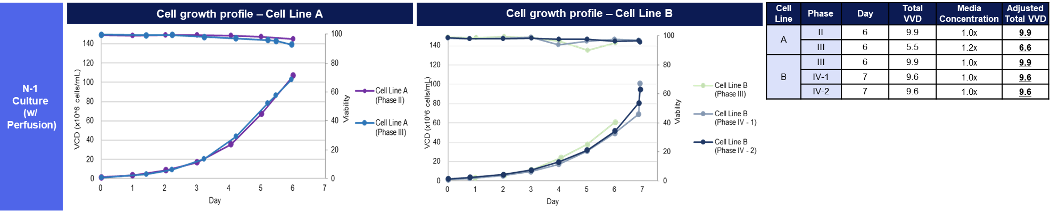 Figure 1. N-1 culture performance across S-Tensify™ Phase II-IV development for Cell Lines A and B, including cell-growth profiles and VVD strategies.
Adapting the N-1 Strategy to Cell-Growth Behavior
The value of this flexibility became clearer when Samsung Biologics evaluated a newer cell line used for production. Unlike the cell line that had reached the Phase II N-1 target of 100 × 106 cells/mL, Cell Line B exhibited a lower inherent SPGR and did not reach the same density under the existing conditions.
Samsung Biologics therefore evaluated several ways to generate the cell population needed for the production culture: increasing N-1 inoculation cell density, extending the N-1 culture duration by one day, and concentrating the cells using ATF on the final day before transfer.
Phase III provided an early example. Cell Line B reached 60.7 × 10⁶ cells/mL during N-1 culture, after which ATF concentration increased the cell density to 104.2 × 10⁶ cells/mL for inoculation. Phase IV then evaluated higher inoculation densities alongside a seven-day N-1 culture. Starting at 1.5 × 10⁶ cells/mL, the culture reached 69.1 × 10⁶ cells/mL before concentration and 101.0 × 10⁶ cells/mL afterward. Increasing the initial cell density to 2.0 × 10⁶ cells/mL produced 80.6 × 10⁶ cells/mL before concentration and 94.6 × 10⁶ cells/mL afterward. Final viability remained above 96% under both Phase IV conditions. Together with the VVD optimization for Cell Line A, these results illustrate the different N-1 strategies evaluated as S-Tensify™ was adapted to different cell-growth characteristics, as shown in Figure 1.
These experiments also refined Samsung Biologics’ approach to the N-1 VCD target itself. The 100 × 106 cells/mL target was applied in the Phase II–IV development studies, but it is not intended as a universal requirement. The broader objective is to increase cell density while maintaining cell health and keeping cells in the exponential growth phase before transfer to the main culture. The optimal N-1 VCD can therefore vary with cell-line characteristics.
Cell growth and existing productivity are especially important when choosing the right strategy. Growth behavior influences the achievable level of intensification, while existing productivity establishes the baseline for improvement. Because Samsung Biologics expects to use S-Tensify™ primarily in process-redevelopment settings, these characteristics can often be assessed using process and performance data available at the outset of a project.
Extending Optimization Into the Main Culture
Phases III and IV applied the same cell-line-specific logic to the production culture. Rather than assuming that the nutrient strategy established for one cell line would transfer directly to another, Samsung Biologics used spent-media analysis to investigate media composition, nutrient requirements, feed selection, and feeding strategies.
Following Phase II, Samsung Biologics used spent-media analysis to compare amino acid profiles and guide the selection of two additional feeds with different amino acid compositions. In Phase III, the original Phase II feed remained the best-performing option for Cell Line A, while the newer cell line performed best with a different feed. This contrast demonstrated that nutrient requirements were cell-line-dependent, underscoring the importance of incorporating feed screening into the S-Tensify™ development strategy.
The newer cell line also provided a more specific clue for further optimization. One amino acid was nearly depleted midway through the main culture, indicating a potential nutrient limitation. Samsung Biologics subsequently evaluated additional supplementation and, in Phase IV, screened another feed containing a higher level of that amino acid.
That strategy translated into higher productivity. With 1.0× basal medium and Feed A, the optimized Phase IV process achieved a final titer of 10.16 g/L, representing a 2.10-fold increase over the 4.84-g/L traditional fed-batch reference. Feed B, which contained a higher level of the potentially limiting amino acid, increased the final titer further to 11.42 g/L, or 2.36 times the traditional fed-batch result.
The objective is therefore not to identify a single universal feed, but to use nutrient behavior to guide selection of the most appropriate feeding strategy for each cell line.
Increasing Flexibility Through Basal-Media Optimization
The nutrient analysis also informed another Phase IV objective. Through Phase III, S-Tensify™ relied on a customized basal medium that could be concentrated. Although this characteristic supported the earlier development strategy, relying on it narrowed the range of media Samsung Biologics could consider for cell lines with different requirements.
Spent-media analysis showed that increasing basal-media concentration did not substantially increase amino acid levels. The company therefore shifted the strategy toward standard-concentration basal medium, with nutrients supplied through an amino acid-rich feed. The optimized Phase IV feeding strategy began daily feeding on Day 0.
Using standard-concentration basal medium, the Feed A process reached a titer of 10.16 g/L in 14 days, slightly exceeding the 10.10 g/L achieved with the earlier 16-day S-Tensify™ condition. The Feed B condition further increased the titer to 11.42 g/L. Figure 2 brings together the main-culture results from Phases III and IV, showing changes in cell growth and normalized productivity as feed and basal-medium strategies were optimized, alongside the available product-quality readouts.
Removing the requirement for concentrated basal medium expands the range of basal media Samsung Biologics can screen for a new cell line and allows the company to optimize basal-medium selection and feeding strategy according to the needs of each process. Phase IV thus broadened platform flexibility while retaining and, in one case, improving productivity.
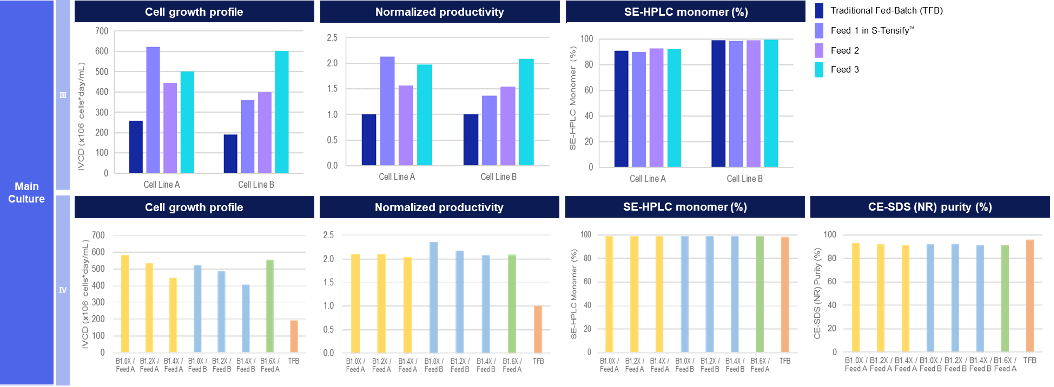 Figure 2. Main-culture performance during S-Tensify™ Phase III and IV development, including Phase III results for Cell Lines A and B and Phase IV media and feed optimization for Cell Line B.
Optimizing the Entire Culture Process
The Phase IV work also illustrates why an intensified upstream process should be evaluated as an integrated sequence rather than as independent N-1 and production stages. Samsung Biologics considers overall COGS a primary factor when balancing competing objectives. Higher titer is desirable, but media consumption and culture duration also affect process efficiency.
Each stage therefore needs to be optimized for its particular function. For N-1, the objective is to generate enough healthy cells to achieve the appropriate inoculation density in the production culture. Because the newer cell line exhibited a lower SPGR, Samsung Biologics extended N-1 culture by one day. In the main culture, the objective is to achieve target productivity, which Phase IV achieved in 14 days, compared with 16 days in the earlier S-Tensify™ condition.
The result was a useful whole-process trade-off: one additional N-1 day supported the cell population required for production, while two days were removed from the main culture, reducing overall culture duration by one day. The optimized sequence therefore did not require every individual stage to become shorter or consume fewer resources; it required the complete process to deliver the desired productivity more efficiently.
Evolving S-Tensify™ Into a More Adaptable Platform
For process-redevelopment applications, existing growth and productivity data can provide an early understanding of a sponsor cell line’s behavior and inform the initial S-Tensify™ development strategy. Samsung Biologics can use that information to determine which process parameters warrant evaluation, including N-1 inoculation density and culture duration, VVD, ATF concentration, basal and feed media, and feeding strategy. This approach preserves the platform’s structure while allowing development to respond to the specific biology and objectives of the sponsor process.
The accumulated development work therefore supports a flexible strategy for optimizing both N-1 and the main culture according to sponsor objectives and cell-line characteristics. Since its original launch, S-Tensify™ has evolved from a platform that demonstrated the benefits of IFB processing to one focused on productivity, process efficiency, and applicability across different cell lines.
Conclusion: From Process Intensification to Intelligent Optimization
The continued development of S-Tensify™ demonstrates that effective process intensification does not require every cell line to follow the same path to maximum density or productivity. By expanding the available optimization levers and leveraging its experience applying them, Samsung Biologics can tailor combinations of N-1 growth, VVD, cell concentration, basal and feed media, feeding strategy, and culture duration to cell-line behavior and process objectives. This approach preserves the productivity advantages of IFB processing while addressing media consumption, process duration, process flexibility, and overall COGS.