
Key takeaways
The 2025 M&A “boom” was defined less by deal count than by scale, with average deal sizes nearly doubling as acquirers concentrated capital on high-confidence assets and platforms.
Large pharma balance sheets were not a constraint; instead, capital abundance enabled selective, high-conviction transactions despite regulatory, geopolitical, and market uncertainty.
Deal activity clustered around late-stage and marketed assets, with therapeutic emphasis shifting toward CNS, cardiometabolic disease, and immunology alongside a still-active oncology landscape.
CDMO investment and consolidation accelerated in parallel, driven by reshoring, capability acquisition, and the rise of end-to-end manufacturing platforms as strategic differentiators.
Looking to 2026, consolidation is expected to continue through disciplined dealmaking, narrower but deeper therapeutic bets, and more flexible transaction structures that balance risk, integration, and long-term growth
A Boom Defined by Scale, Selectivity, and Strategy
The resurgence of mergers and acquisitions (M&A) activity in 2025 is best understood not as a return to the high-volume dealmaking of prior cycles but as a shift toward fewer, larger, and more consequential transactions. While the total number of deals declined relative to earlier peaks, the year was marked by a sharp increase in average deal size and a pronounced acceleration in activity toward the latter part of the year. This pattern reflected a market in which buyers acted with greater precision, concentrating capital on assets and platforms viewed as strategically essential rather than opportunistic. The result was a form of consolidation driven less by breadth and more by depth, with transactions increasingly tied to long-term portfolio repositioning across large pharmaceutical and biotechnology companies.
A defining feature of this environment was that capital availability was not the limiting factor. Large pharmaceutical companies entered 2025 with substantial balance-sheet capacity, collectively holding approximately $1.3 trillion in deployable capital across the top 25 firms. This level of financial firepower provided buyers with the flexibility to pursue sizable acquisitions even as macroeconomic, regulatory, and geopolitical uncertainties persisted. Rather than deterring dealmaking, these uncertainties appeared to reinforce a preference for selective, high-confidence transactions, particularly those offering late-stage assets, near-term revenue potential, or durable strategic capabilities.
Looking ahead, the dynamics that shaped 2025 have set expectations for continued momentum into 2026. Major financial institutions have projected that the coming year could represent a record period for pharma and biotech M&A, supported by strong corporate balance sheets and an accumulation of unmet strategic needs. The surge in late-2025 activity, including several multi-billion-dollar transactions clustered toward year-end, has reinforced the view that dealmaking was delayed rather than abandoned and that the underlying drivers of consolidation remain firmly in place as the industry enters the next phase of its evolution.
What Actually Happened in 2025: Fewer Deals, Bigger Bets
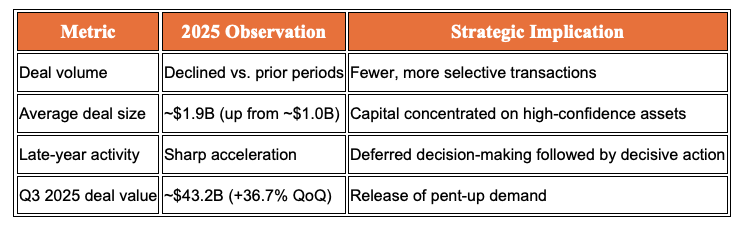
The defining feature of 2025 dealmaking was the widening gap between deal volume and deal value. While the overall number of transactions declined, the capital committed to individual deals increased markedly. Average deal size nearly doubled year over year, rising from approximately $1.0 billion to $1.9 billion, underscoring a clear shift in how acquirers deployed capital. Rather than pursuing multiple smaller transactions, buyers concentrated resources on a narrower set of assets and companies deemed capable of materially reshaping portfolios or addressing specific strategic gaps.1
This divergence reflects a broader move toward precision dealmaking. With pipeline productivity under pressure and competition for high-quality assets intensifying, acquirers appeared less willing to spread capital across speculative or early-stage opportunities. Instead, emphasis shifted toward transactions with clearer clinical, regulatory, or commercial line of sight. The result was a market characterized by selectivity and conviction, in which fewer deals carried greater strategic weight.
Timing also played a critical role in shaping the 2025 narrative. After a relatively measured start to the year, deal activity accelerated meaningfully in the second half, culminating in a pronounced surge during the third quarter and beyond. Reported M&A deal value increased by 36.7% on a quarter-over-quarter basis in the third quarter of 2025, reaching $43.2 billion, signaling a release of pent-up demand rather than a sudden shift in underlying fundamentals.2
The concentration of multi-billion-dollar transactions toward the end of the year further reinforced this pattern. Several large acquisitions were announced in close succession, suggesting that prospective buyers waited for greater macroeconomic, regulatory, and market clarity before committing capital. Once that clarity emerged, decision-making accelerated, and transactions that had likely been under evaluation for months moved forward rapidly. This late-year clustering supports an analytical interpretation of 2025 as a year of deferred action followed by decisive execution, rather than one of sustained hesitation.
Table 1. 2025 Pharma & Biotech M&A: Volume vs. Value Snapshot
 Where the Money Went: Therapeutic and Asset Concentration
A closer look at 2025 deal composition reveals a pronounced concentration around late-stage and marketed assets. Transactions involving marketed products or phase III candidates accounted for approximately 58% of total deal value, underscoring a strong preference for assets with near-term revenue potential and reduced clinical risk. This pattern reflects an environment in which acquirers prioritized visibility and predictability, favoring programs that could meaningfully contribute to growth in the short to medium term over earlier-stage opportunities with longer development horizons.1
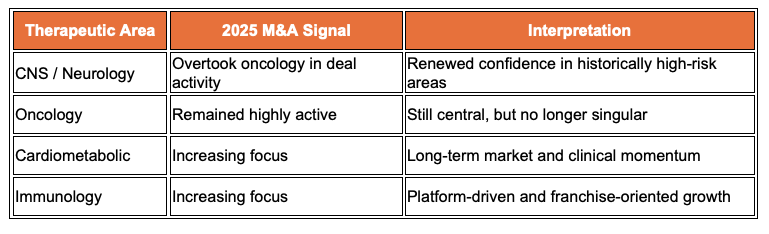
Therapeutic priorities also evolved over the course of the year. While oncology remained a core area of focus, it was no longer the sole center of gravity for dealmaking. Central nervous system (CNS) and neurology assets overtook oncology as the most active therapeutic category during the first 10 months of 2025, signaling renewed confidence in areas that have historically been viewed as higher risk but strategically important. At the same time, cardiometabolic disease and immunology emerged as areas of growing interest, positioned by multiple observers as likely focal points for future transactions as scientific advances and market demand converge.1,3
Table 2. Therapeutic Concentration in 2025 M&A Activity
 Geography added another important layer to this concentration. Roughly 35% of deals announced in 2025 originated in China, highlighting the country’s continued role as a significant source of innovation for global pharma and biotech companies. This pattern reinforces the increasingly global nature of early discovery and clinical development, even as other parts of the value chain evolve differently. Analytically, the prominence of China-originated assets underscores a split within the industry: innovation sourcing remains global, while downstream considerations, such as manufacturing location and supply-chain resilience, are increasingly shaped by regional and national priorities. This tension sets the stage for later discussion of reshoring and localization trends, particularly as companies seek to balance access to global science with greater operational control.1
The Deals That Defined the Year
Several high-profile transactions in 2025 crystallized the strategic logic underpinning the broader M&A landscape, serving not only as headline events but as signals of where large pharmaceutical companies were placing their longest-term bets. Chief among these was Johnson & Johnson’s $14.6 billion acquisition of Intra-Cellular Therapies, widely characterized as the largest biotech transaction of the year. More than a single-asset play, the deal underscored a sustained commitment to neuroscience and mental health as durable growth areas, reflecting confidence that advances in CNS biology, biomarkers, and clinical trial design are beginning to translate into commercially viable franchises. The scale of the transaction suggests that large pharma companies are increasingly willing to absorb complexity and risk in exchange for leadership positions in therapeutic areas once considered prohibitively uncertain.4,5
Table 3. Defining Deals of 2025 (Illustrative, Not Exhaustive)
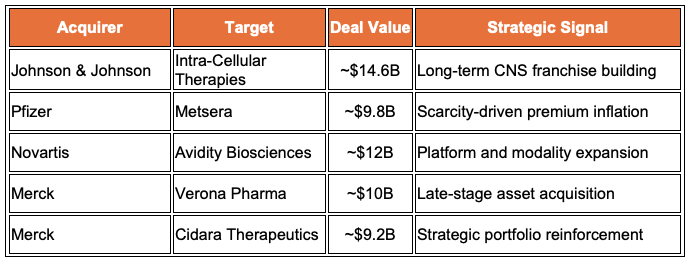 The competitive dynamics surrounding other transactions further highlighted the scarcity of differentiated, high-quality assets. The bidding contest between Pfizer and Novo Nordisk for Metsera offered a clear illustration of this pressure. What began as a lower-valued offer escalated into a contest that ultimately valued the company at approximately $9.8 billion. This episode reflects more than simple competitive enthusiasm; it points to a structural imbalance between the supply of late-stage, high-conviction assets and the demand from cash-rich acquirers seeking to secure future growth. As a result, premiums have expanded for programs perceived as both scientifically compelling and strategically aligned, reinforcing the idea that valuation discipline in 2025 was exercised through selectivity rather than price restraint.5
Late-year activity reinforced these themes and dispelled any notion that the largest deals of 2025 were outliers. Novartis’ roughly $12 billion acquisition of Avidity Biosciences, along with Merck’s acquisitions of Verona Pharma for approximately $10 billion and Cidara Therapeutics for about $9.2 billion, arrived in close succession toward the end of the year. Collectively, these transactions demonstrated that buyer appetite not only persisted but intensified as the year progressed. They also spanned a range of therapeutic areas and modalities, underscoring that the underlying driver was not a single hot indication, but a broader imperative to secure differentiated platforms and assets capable of supporting long-term portfolio renewal.2
Taken together, these deals should be viewed less as anomalies and more as confirmations of the defining trends of 2025. Large pharma companies were willing to commit substantial capital when assets met a high strategic bar, competition for such assets drove valuations upward, and decision-making accelerated once uncertainty eased. The concentration of these transactions in the latter part of the year further reinforces the view that 2025 was characterized by delayed but decisive action, setting a precedent for how consolidation may continue to unfold as the industry moves into 2026.
Why 2025 Looked the Way It Did: Strategic Drivers
The patterns that defined M&A activity in 2025 were shaped less by opportunism than by a deliberate recalibration of strategy among large pharmaceutical and biotechnology companies. Observers consistently characterized the year’s dealmaking as targeted and asset-centric, with transactions designed to fill clearly defined pipeline gaps rather than to expand organizational footprint for its own sake. Acquirers focused on assets that could address specific scientific, therapeutic, or commercial needs, reinforcing a model of precision over empire-building. Within this framework, programs with clean safety profiles, advanced clinical status, and identifiable near-term catalysts emerged as gating factors for serious consideration, narrowing the field of viable targets but increasing conviction when deals moved forward.3
Patent pressure formed a critical backdrop to these decisions. As multiple large products across the industry approach loss of exclusivity, the need to secure replacement revenue streams has become increasingly acute. BioXconomy framed the 2025 wave of biotech acquisitions as occurring in anticipation of this looming patent cliff, with companies acting proactively to shore up future portfolios rather than reacting to revenue erosion after the fact. Analytically, this dynamic can be described as urgency without panic: buyers moved decisively, but largely within disciplined strategic parameters, prioritizing assets that could be integrated into long-term growth narratives rather than pursuing defensive, last-minute acquisitions.4
At the same time, caution at the margins helped shape the pacing of activity throughout the year. Regulatory and policy uncertainty, including concerns around tariffs, trade dynamics, and potential disruption within the U.S. Food and Drug Administration (FDA), introduced hesitation in certain segments of the market. These factors did not suppress dealmaking outright, but they did encourage buyers to delay decisions until greater clarity emerged. The result was a pattern of measured evaluation followed by concentrated execution, helping to explain both the subdued early-year environment and the pronounced surge in transactions later in 2025. In this context, uncertainty functioned less as a deterrent and more as a timing mechanism, influencing when deals were announced rather than whether they occurred at all.1
CDMO M&A, Capacity Expansion, and the Manufacturing Layer
While much of the 2025 M&A narrative focused on therapeutic assets and pipeline renewal, developments on the manufacturing side of the industry were no less consequential. Contract development and manufacturing organizations (CDMOs) emerged as a central arena for investment, consolidation, and strategic repositioning, reflecting a broader reassessment of manufacturing’s role in competitiveness and resilience. Tracking of industry activity identified $24.86 billion in disclosed CDMO investment during 2025, spanning 732 announced projects and transactions. The sheer scale of this activity signals a decisive shift away from viewing manufacturing primarily as a cost center and toward treating it as a strategic asset essential to supply security, speed, and long-term control.6
Geography was a defining feature of this transformation. Approximately 74% of tracked CDMO capital investment flowed into the United States, with $18.48 billion allocated to domestic projects. Investment peaked sharply in September 2025 alone, when $7.17 billion in disclosed spending was recorded, making it the single most active month of the year. Industry observers characterized U.S.-based manufacturing expansion as a defining theme of 2025, driven by a combination of trade policy considerations, supply chain risk mitigation, and a renewed emphasis on domestic production capabilities. Rather than incremental capacity additions, many of these investments represented large-scale commitments to regional manufacturing footprints intended to support long-term demand and regulatory alignment.6,7
Consolidation within the CDMO sector has also been shaped by capability requirements as much as by scale. Data cited by EY show that between 2017 and 2021 there were 244 publicly announced M&A transactions involving CDMOs, providing a baseline for understanding the current cycle. Notably, roughly one-third of those transactions were focused on novel modalities, and the share of CDMO deals involving such technologies increased from 29% in 2017 to 40% by 2021. This trend underscores that consolidation has increasingly targeted specialized technical expertise, such as advanced biologics, cell and gene therapies, and other emerging modalities, rather than simple capacity aggregation. The persistence of this pattern into 2025 suggests that acquirers continue to prioritize differentiated capabilities that are difficult to build organically.
Alongside specialization, CDMOs have been broadening their scope across the value chain. EY has observed a steady expansion of CDMO offerings toward more integrated, end-to-end platforms encompassing development, manufacturing, and commercial-scale production. This evolution reflects both competitive pressure within the CDMO landscape and changing expectations among pharmaceutical sponsors. Analytically, the convergence of CDMO capabilities mirrors pharma’s own strategic shift toward fewer, more integrated partners capable of supporting programs from early development through commercialization. In this sense, consolidation in the CDMO sector is not merely a response to market fragmentation, but part of a larger realignment in how drug development and manufacturing ecosystems are structured to support increasingly complex portfolios.
Looking Ahead to 2026: What Consolidation May Bring
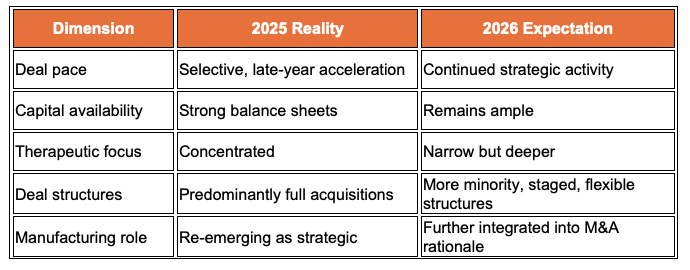
The forces that shaped dealmaking in 2025 are expected to persist — and in some cases intensify — as the industry moves into 2026. Strategic advisors have emphasized that the conditions for continued M&A activity remain firmly in place, with large pharmaceutical and biotechnology companies entering the year with strong balance sheets and substantial deployable capital. Rather than signaling a peak, the concentration of transactions in late 2025 is widely interpreted as evidence of momentum carrying forward, reinforcing expectations that strategic dealmaking will accelerate rather than cool in the near term.3
As this next phase unfolds, therapeutic focus is likely to remain relatively narrow but increasingly deep. Cardiometabolic disease, CNS disorders, oncology, and immunology have been consistently identified as core arenas for future activity, reflecting both unmet medical need and the maturation of enabling science in these areas. Analytically, this points to a consolidation strategy centered on depth over breadth: instead of diversifying across a wide array of indications, acquirers appear poised to double down on select therapeutic franchises, building scale, expertise, and competitive advantage within defined domains.3
Deal structures themselves are also expected to evolve. Observers anticipate greater flexibility in how transactions are executed, with increased use of minority investments, majority stakes, and staged or option-based structures alongside traditional full acquisitions. This experimentation suggests a growing emphasis on risk-sharing and integration pacing, allowing buyers to balance strategic commitment with optionality in an environment marked by scientific complexity and regulatory uncertainty. Collectively, these trends point toward a 2026 M&A landscape defined not only by continued consolidation, but by more nuanced and adaptable approaches to partnership and ownership as companies seek to align long-term strategy with disciplined capital deployment.3
Table 4. What Changes—and What Doesn’t—Heading Into 2026
 Conclusion: From Opportunistic Buying to Structural Realignment
Taken together, the patterns that defined 2025 suggest that the industry has reached an inflection point in how consolidation is pursued and justified. The year did not mark a simple return to earlier eras of high-volume M&A, nor did it reflect a transient burst of opportunistic buying driven by short-term market conditions. Instead, 2025 signaled a move toward more disciplined consolidation, characterized by selective capital deployment, higher strategic thresholds for transactions, and a willingness to commit substantial resources when assets or platforms aligned clearly with long-term priorities.
This shift is reshaping the structure of the industry itself. Pharmaceutical and biotechnology companies are consolidating around a smaller number of higher-value assets, concentrating investment in therapeutic areas and programs that can anchor durable franchises. At the same time, consolidation among CDMOs is proceeding along complementary lines, with emphasis on specialized capabilities, geographic presence, and the ability to offer integrated support across the development and manufacturing lifecycle. Together, these trends point toward a more concentrated and more interconnected ecosystem, in which strategic alignment across discovery, development, and production is increasingly central to competitive advantage.
Looking ahead, several open questions will shape how this realignment unfolds. It remains to be seen how far consolidation will extend before countervailing forces, such as valuation discipline or regulatory scrutiny, begin to exert greater influence. The geography of innovation also warrants continued attention, particularly as global discovery networks coexist with more localized manufacturing strategies. Finally, as manufacturing considerations become more tightly woven into deal logic, the balance between flexibility, resilience, and scale will play an increasingly prominent role in shaping M&A decisions. How companies navigate these tensions will help define not only the trajectory of consolidation in 2026 and beyond, but the contours of the pharmaceutical and biotechnology industry in the years to come.
References
1. Bilodeau, Kelly. “Will 2026 be pharma’s M&A breakout year?” PharmaVoice. 10 Dec. 2025.
2. Barrie, Robert. “Biopharma’s 2025 M&A boom: Dealmaking surges as patent pressures intensify.” Pharmaceutical Technology. 12 Dec. 2025.
3. “US Deals 2026 outlook: Pharmaceutical and life sciences.” pwc. 16 Dec. 2025.
4. Ohaka, Nnenna. “BioXconomy’s top 10 M&A deals of 2025.” BioXconomy. 16 Dec. 2025.
5. Samorodnitsky, Dan. “The 7 Most Impactful M&A Deals of 2025.” Biospace. 17 Dec. 2025.
6. “The Great Reshoring: How $24.86 Billion Reshaped CDMO Manufacturing in 2025.” PharmaSource. 17 Dec. 2025.
7. van Arnum, Patricia. “CDMOs/CMOs: The Movers and Shakers of 2025.” DCAT Value Chain Insights. 11 Dec. 2025.