Samsung Biologics replaced manual environmental monitoring documentation with a fully integrated digital sampling system, which has improved data compliance, reduced operational risk, and strengthened the foundation for data-driven biomanufacturing.
Digitalization is Reshaping Modern Biopharmaceutical Manufacturing
The biopharmaceutical pipeline is becoming more complex and diverse, placing new demands on modern biologics manufacturers. As therapeutic modalities expand and production processes grow more sophisticated, manufacturers must manage increasingly complex operational environments while maintaining strict compliance with evolving regulatory expectations.
This mounting pressure is accelerating the adoption of digital systems across biopharmaceutical manufacturing operations. Electronic lab notebooks (ELNs), laboratory information management systems (LIMS), manufacturing execution systems, and digital environmental monitoring (EM) platforms, such as particle measuring systems, are becoming standard components of modern quality and manufacturing infrastructure. These technologies support reliable data capture, improved traceability, and greater operational visibility across manufacturing processes.
EM and sampling programs are critical for contamination control in cleanrooms and other controlled production environments. Monitoring activities, such as the evaluation of air, surface, water, personnel, and compressed gas samples for microbial contamination to ensure that manufacturing environments remain within validated control limits, are essential for maintaining the quality, safety, and efficacy of drug products and regulatory compliance.
EM in large-scale biologics facilities generates substantial operational and documentation demands. Each sample must be properly recorded, reviewed, and archived in accordance with good manufacturing practice (GMP) requirements, creating a significant administrative burden as sampling volumes increase. As a result, many organizations are exploring paperless sampling approaches that combine automated monitoring systems with digital documentation workflows. These systems improve traceability while reducing the risk of transcription errors, cross-contamination from paper forms, and inefficiencies related to manual record management.
As the scale of EM increases, so do the related challenges. Samsung Biologics, for example, collects approximately 600,000 environmental and utility monitoring (UM) samples annually, generating roughly 30,000 sampling records to be documented, reviewed, and archived.
To address these challenges and support the company’s broader digital transformation strategy, Samsung Biologics is transitioning to fully paperless sampling for EM and UM.
Sampling information that was previously recorded manually is automatically captured in ELNs in standardized digital forms, reducing human error and improving data reliability while eliminating cross-contamination risk from paper documents that cannot be disinfected. Users can access sampling records instantly, and real-time audit trails readily capture changes, enhancing traceability and supporting compliance with 21 CFR Part 11 Section 3 (Audit Trail) requirements. In addition, ELN-based documentation satisfies Section 5 (Record Retention) requirements by ensuring that records are securely protected and readily retrievable throughout the retention period.
Documentation Requirements
EM and UM sampling documentation requirements are extensive and highly structured. Each sample requires complete, traceable data, including:
Sampling location
Operator identity
Sampling time
Equipment identification
Analytical results
These data points ensure traceability, support contamination control, and maintain GMP compliance.
For each additional sample, multiple data fields must be recorded, verified, and stored. The complexity of the required documentation increases significantly as scale grows, placing a burden on large-scale biologics manufacturing facilities and making efficient management of this information a critical operational challenge.
Operational Limitations of Paper-Based Sampling
Paper-based documentation for EM and UM sampling data presents a range of operational and compliance challenges. Paper forms can be misplaced, damaged, or improperly archived, and manual transcription introduces a measurable risk of data entry errors and delays in recording sampling results. In cleanroom environments, paper documents present practical difficulties because they cannot be easily sanitized or sterilized.
Paper-based workflows also create data management challenges: Physical records must be printed, distributed, collected, and archived, creating significant administrative overhead. Retrieving records from archives for audits or investigations can be time-consuming, and establishing complete, reliable audit trails is challenging. It is also difficult to share sampling data across teams, perform efficient data searches, and gain real-time visibility into monitoring activities.
Before Samsung Biologics implemented a paperless EM/UM sampling system, operators documented sampling activities using paper forms and conducted monthly reviews of audit trail logs directly on the monitoring devices. Operators then backed up these logs manually to a USB drive. In addition, storage capacity on the devices themselves was limited, which constrained long-term data retention and traceability. This inefficiency created a risk of transcription errors and documentation gaps.
Designing a Fully Digital Sampling Infrastructure
For a paperless EM and UM sampling system, each step in the sampling workflow must be digitized and automated, including the physical sampling process as well as data documentation, storage, and management.
At Samsung Biologics, transitioning to a fully digital sampling workflow required several technological and procedural changes. The company developed a dedicated ELN platform, integrated it with the existing LIMS, and interfaced air particle counters (APCs) with the LIMS through the APC interface, which enabled remote operation of sampling devices and automated data transmission.
The system architecture automated the capture of sampling metadata, raw monitoring data, and audit trail records while strengthening data compliance by creating individual user accounts and system-generated timestamps as well as secure centralized data storage.
Under the new system, sampling devices can be operated remotely through the LIMS. The ELN automatically captures sampling information and results in standardized digital forms, eliminating manual transcription and significantly reducing the risk of human error. The system automatically generates audit trails in real time, and operators perform routine audit trail reviews directly within the LIMS, with command logs retained in the system for traceability (Figure 1).
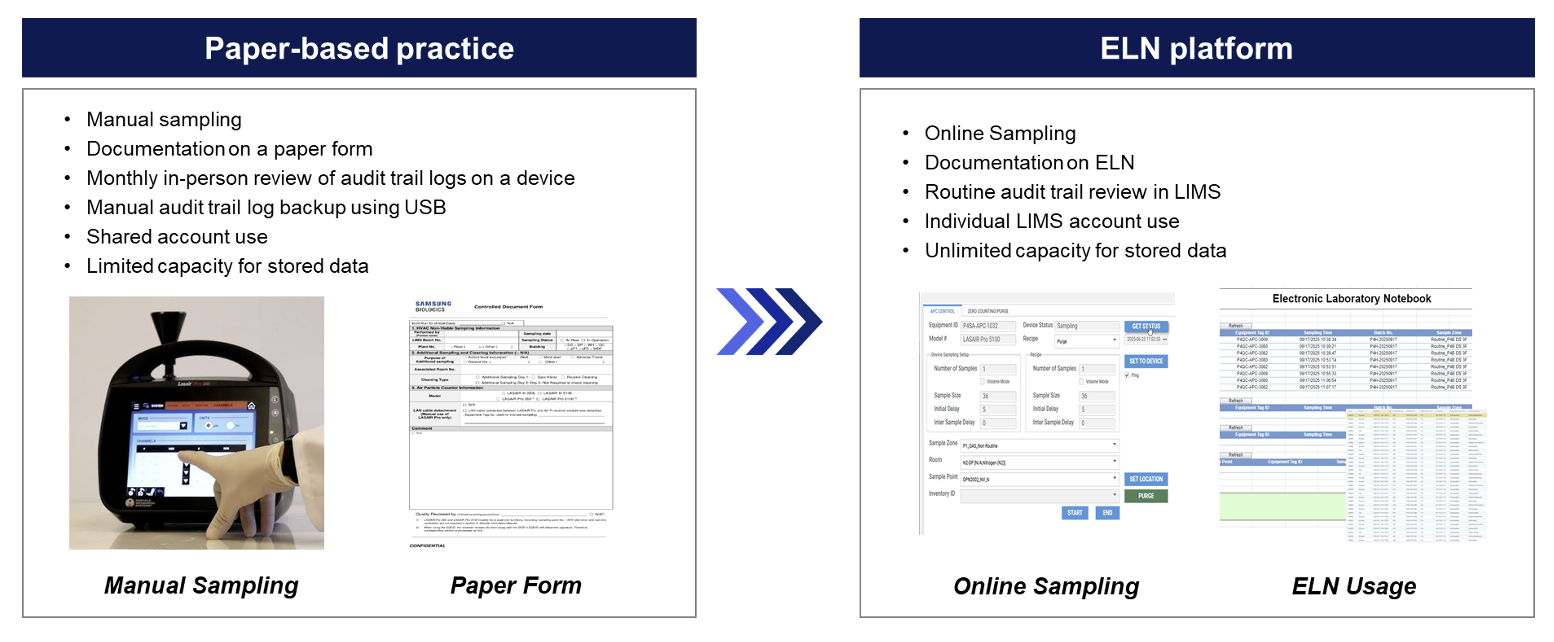 Figure 1. Full transition from manual paper-based practice to Samsung Biologics’ ELN platform
This digital infrastructure strengthens compliance with 21 CFR Part 11 requirements for electronic records, including audit-trail and record-retention provisions. Samsung Biologics shifted access management from device-level controls to the LIMS interface, which enhances user authentication and privilege control while improving access control and data security through individual LIMS accounts. In addition, centralized storage eliminates data capacity limitations.
The digitization of EM/UM sampling has centralized data monitoring, to enable more efficient data management, review, and trend analysis. Building on this foundation, Samsung Biologics is continuing to advance its digitization road map. Additional sampling-related processes, including scheduling, batch creation, and data entry, are automated. The current paperless sampling system, therefore, serves as a foundation for broader automation of monitoring operations.
System Integration and Infrastructure Upgrade
Effective implementation of the paperless EM/UM sampling system required tight integration between the LIMS, ELN platform, and APC firmware environment. This integrated architecture enables the system to capture, process, and store sampling data entirely within the LIMS environment, eliminating the need for separate external processes. As a result, operators can efficiently track sampling information while maintaining secure data management and complete traceability.
Establishing this integrated system required a series of technical and operational development steps. Initial efforts focused on comprehensive test planning and risk assessment to identify potential integration gaps. The team analyzed communication protocols between monitoring equipment and the LIMS to enable bidirectional data exchange and, where necessary, developed firmware updates for existing APC devices. The team also modified the LIMS to support remote APC operation and automated data collection.
Additional enhancements ensured compatibility with the ELN workflow. These included updates to the LIMS data structure and the introduction of new batch types, including evaluation, gowning qualification, and aseptic qualification batches, to enable standardized form completion within the ELN environment.
Hardware was upgraded to support network-enabled sampling devices. The team installed Wi-Fi receiver modules on APC units and upgraded the wireless infrastructure to ensure reliable network connectivity for real-time data transmission between devices and the LIMS. To ensure that the Wi-Fi receivers properly received data signals from the wireless transmitter in each facility, numerous APC Wi-Fi models were evaluated, and the most compatible Wi-Fi receiver models were selected and installed. Integration testing was then performed to verify APC operation, data processing, and secure transmission of monitoring data to the LIMS. The team also identified and eliminated communication dead zones within the cleanrooms by installing additional access points and upgrading APC connectivity, thereby enabling consistent wireless communication across the monitoring network.
System validation involved multiple layers of testing. APC devices were connected through a validation server, and non-script testing was used to evaluate LIMS functionality. This step was followed by formal user acceptance testing with predefined test scripts. Any issues identified during testing were monitored and addressed before deployment, and procedures were updated to support routine monitoring operations in the new system.
Full integration required the development and verification of approximately 822 APC interfaces across the facility. The team also developed new procedures and digital templates to support ELN-based sampling workflows.
Implementation Strategy and Organizational Adoption
Transitioning from paper-based workflows to a fully paperless EM/UM sampling system across the organization required a structured and deliberate implementation strategy. Samsung Biologics began by establishing a clear development road map and forming a cross-functional working group to design and deploy the new system.
Initially, a limited pilot program allowed teams to evaluate the new workflow under real operating conditions and identify areas for refinement. Insights from the pilot phase informed further system development before broader deployment. Once the system design was finalized, training sessions and informational seminars prepared operational teams for adoption.
User feedback was critical during system rollout. While the team conducted extensive testing during development, certain real-world conditions could not be fully replicated. For example, complete validation of wireless connectivity across all cleanroom environments was not feasible during pre-launch testing. Operator feedback helped identify previously undetected Wi-Fi dead zones, enabling targeted infrastructure improvements. Similarly, the simultaneous use of multiple devices under routine operating conditions revealed integration challenges, particularly with APC interfaces, that were addressed to improve system stability.
A phased implementation approach allowed each manufacturing unit to receive focused support during the transition, minimizing disruption and enabling a smoother path to enterprise-wide adoption. This approach also created opportunities to incorporate user feedback iteratively, strengthening system performance and usability.
Development of the paperless ELN sampling system began in July 2023, with full organizational implementation completed just over two years later (Figure 2). Despite the scale of change, user adoption progressed rapidly. Operational teams adapted quickly to the new workflows, actively identified issues, and contributed to ongoing improvements. This level of engagement accelerated system stabilization and reinforced a culture of shared ownership in advancing digital transformation.
 Figure 2. Journey toward 100% paperless sampling
Measured Operational and Quality Improvements
The paperless EM/UM sampling system delivered a range of operational and quality improvements across Samsung Biologics’ manufacturing activities. Many of the anticipated benefits of digitization were realized quickly, while additional advantages emerged as the system matured.
Sampling activities are easier and more efficient for operators, as digital workflows eliminate manual form handling and data transcription. Data compliance and documentation traceability have improved substantially. In addition, automated capture of sampling data and system-generated audit trails reduce the likelihood of transcription errors and strengthen the reliability of sampling records.
The transition to digital documentation has also reduced deviations associated with manual processes. By eliminating paper-based forms and manual data entry, the system significantly decreases the risk of transcription and record-management errors. When issues arise, centralized digital records allow teams to identify and correct errors more efficiently.
Operational efficiencies have also increased. The need to print, manage, archive, and retrieve paper records has been eliminated, while digital access to sampling information has improved data visibility across the organization. These changes have simplified sampling workflows and reduced administrative overhead.
Collectively, these improvements translate into measurable operational benefits. Samsung Biologics’ paperless sampling initiative significantly reduced costs, decreased manual workload, and enabled more efficient use of personnel resources.
Paperless Systems as a Foundation for Pharma 4.0
Digitalization and automation are accelerating across the biopharmaceutical industry as manufacturers seek more efficient and reliable ways to manage increasingly complex operations. At the same time, GMP regulatory expectations continue to evolve, placing greater emphasis on data compliance, traceability, and rapid access to complete manufacturing records. In addition, digital systems can significantly improve the ability to detect errors, deviations, and data gaps, enabling faster, more effective corrective actions.
The adoption of paperless laboratory and quality systems is an important step in the broader transition toward Pharma 4.0. This transition emphasizes connected systems, real-time data visibility, automation, advanced analytics, and integrated digital workflows that enable quality and manufacturing operations to become more predictive, transparent, and data-driven. Integrated digital platforms strengthen inspection readiness while improving operational efficiency and data transparency across the quality and manufacturing functions. Digital sampling systems create opportunities to support more advanced capabilities, including real time monitoring, enhanced data analytics, and integrated data ecosystems.
The paperless EM/UM sampling initiative at Samsung Biologics illustrates how targeted digitization efforts can improve the integrity and efficiency of manufacturing operations. This initiative forms part of the company’s ExellenS™ optimized biomanufacturing framework, which integrates Samsung Biologics’ manufacturing expertise with operational excellence principles. ExellenS™ emphasizes standardization, simplification, and scalability to enable consistent operations across multiple facilities while supporting faster technology transfers, seamless scaling, and more predictable manufacturing outcomes.
Unified digital systems are central to the ExellenS™ framework. By enabling greater visibility into manufacturing data and improving the efficiency of quality operations, digital infrastructure supports faster regulatory approval, streamlined production scale-up, and greater flexibility for global clients.
Building the Foundation for Data-Centric Manufacturing
Realizing the full benefits of digitalization and automation requires biopharmaceutical manufacturers to modernize legacy workflows that were originally designed for paper-based operations. Samsung Biologics transitioned to paperless EM/UM sampling to improve operational efficiency, strengthen data compliance, and simplify daily workflows for manufacturing personnel while reducing costs associated with manual documentation.
A critical element of this effort was integrating the sampling ELN platform with the company’s LIMS infrastructure. This integration enables more efficient data sharing, centralized data management, and improved traceability while supporting scalable digital workflows across quality and manufacturing operations.
The successful implementation and adoption of the paperless sampling system at Samsung Biologics demonstrates how targeted digitalization initiatives can deliver measurable improvements within GMP-regulated manufacturing environments. By replacing manual processes with integrated digital systems, manufacturers can enhance operational efficiency, strengthen compliance, and build the data infrastructure necessary to support increasingly complex biomanufacturing.