Key Takeaways
Automation and digitalization are transforming aseptic fill–finish manufacturing, helping pharmaceutical companies minimize contamination risk by reducing human intervention and improving process consistency.
Technologies such as robotics, isolators, single-use systems, and automated visual inspection are improving sterility assurance while increasing speed, accuracy, and manufacturing flexibility.
Digital tools including artificial intelligence (AI), machine learning (ML), and digital twins enable predictive modeling, real-time monitoring, and improved process optimization in aseptic operations.
Automation of analytical testing and integration with manufacturing execution systems (MES) strengthen data integrity, traceability, and regulatory compliance in sterile drug production.
Continued advances in Pharma 4.0 technologies are expected to further reduce operator involvement and move the industry toward fully automated aseptic processing environments.
Rising Complexity Is Accelerating Aseptic Automation
Aseptic processing is required for parenteral drug products for which terminal sterilization is not possible but sterility must be assured. That includes most biologic and next-generation therapies, as they would be degraded under typical terminal sterilization conditions.
Effective implementation of aseptic processes has become increasingly challenging as the complexity and diversity of parenteral drug products has increased.1 Even slight deviations can have implications for drug product quality and safety.2 Certain modalities are readily filtered through 0.2-micron sterilizing filters, while others are not. Products formulated with highly potent compounds and radionucleotides pose additional safety challenges for operators and the environment.3 Solutions must also support volumes ranging from the very small for personalized treatments to very large for therapies designed for prevalent diseases.4 The types of formats are increasing as well, with on-body devices and prefilled syringes/pens gaining in popularity, and microdosing and intranasal delivery garnering interest.1,3
Manufacturers are turning to automation and digitalization of aseptic fill/finish processes to address these challenges.4 Automation has been employed for basic filling operations for several decades.5 In the 1970s, awareness of the contamination risks associated with manual manipulations in aseptic processes grew. The need to minimize human intervention was formally recognized in the revised EU GMP Annex 1 published in 2022,6 which emphasizes the need for automation and barrier technologies, among other approaches, to ensure contamination conrol.7,8
The U.S. Food and Drug Administration (FDA) also expects movement by the industry toward automation and the use of technologies that enable improved process monitoring and control. The agency describes aseptic processes as minimizing personal interventions by not involving gowned operators being exposed to open product containers and product contact surfaces.9 Manufacturers are now expected by regulatory agencies to use appropriate available technologies to minimize the risk of contamination.10
Automation Delivers Faster, Safer, and More Consistent Processing
The major sources of contamination during aseptic processing have been identified as personnel, human error, and non-routine activities.11 Digitalization and automation address all three problems by improving repeatability and reducing the need for human intervention.9 Importantly, they provide these benefits, which result in increased quality and yields, while also enabling faster processing speeds and improving operator safety.1,10 Operators not only avoid potential exposure risks but are also freed up to pursue more high-value work.5 Real-time monitoring, meanwhile, allows immediate response to detected problems, minimizing material losses and downtime.1,12 Digitalization also allows for predictive equipment maintenance, automated environmental monitoring, and manufacturing execution system (MES)-integrated bath release.13 Finally, digitalization and automation can reduce operating costs significantly.9
Notable Technology One: Automated Visual Inspection
State-of-the-art, automated visual inspection systems in use today rapidly evaluate products in different formats (e.g., vials and syringes), including highly viscous solutions, for signs of particulates and other contaminants, even during high-speed processing.1 These systems include advanced, high-speed cameras, designs, and software for visual image processing that leverage artificial intelligence (AI) and machine learning (ML) algorithms, with some effectively analyzing hundreds of units per minute.
Notable Technology Two: Single-Use Systems
Automation is facilitated by the implementation of single-use (SU) technology. Use of presterilized disposable assemblies not only reduces risk of contamination, it eliminates the need for clean-in-place (CIP) and steam-in-place (SIP) operations, reducing downtime between production cycles.14 Most SU systems are integrated with automated control and sampling and analysis solutions, as well as advanced software (e.g., digital twins), which together enable more efficient process development and manufacturing, as well as streamlined scalability.15
Notable Technology Three: Robotics
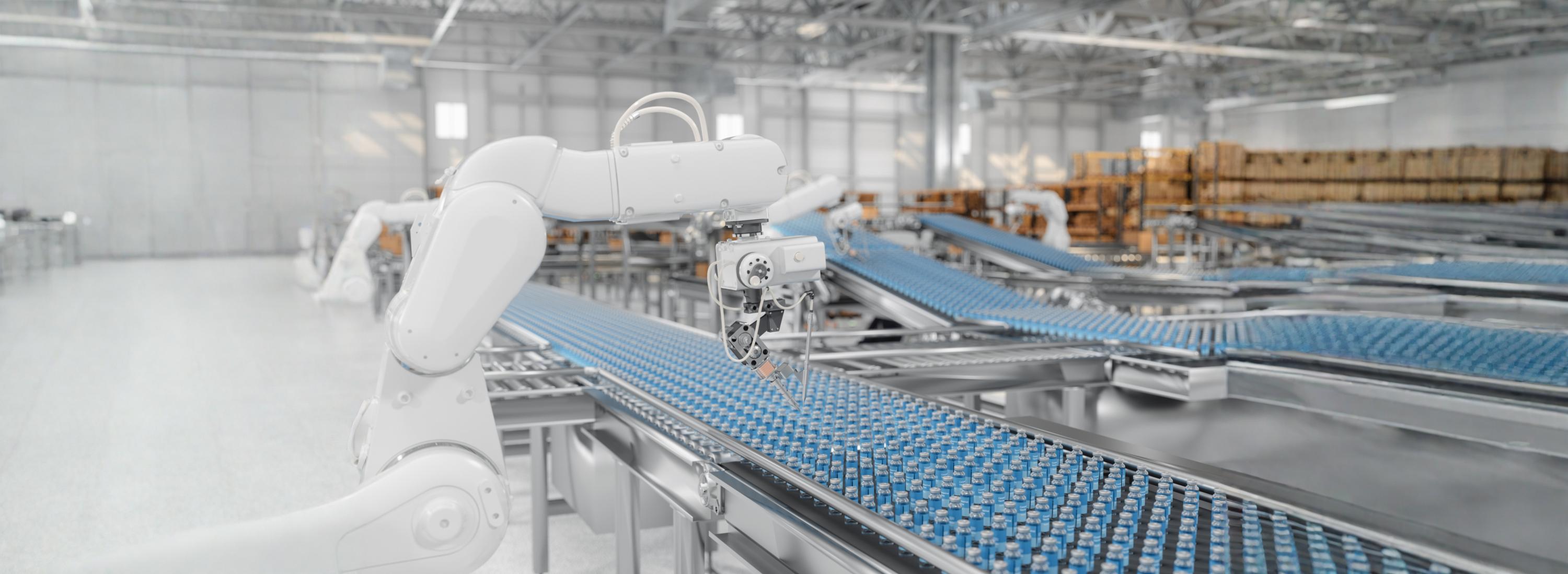
Aseptic filling has been dramatically improved through the use of robotics.1,10,14,16 Robotic systems are used today for many different tasks, including sealing, vial filling, and labeling, among others. These advanced technologies not only replace operators for reduced contamination risk and increased repeatability, precision, and consistency, they also reduce product losses, increase filling accuracy, and can increase efficiency by eliminating certain process steps (e.g., removal of vials from a pre-sterilized tub, avoiding the need for a vial washer and sterilizing tunnel).1,16 Robotic systems also tend to generate low particulate levels and are compatible with harsh sterilization protocols, and thus support a higher level of sterility.10 Manufacturing flexibility is also increased, as robots can be easily programmed to perform different tasks, while humans require extensive training. Similarly, productivity and efficiency are improved.16 For low-volume products, robotics ensure consistent filling, which often is highly challenging for humans to accomplish.14
Notable Technology Four: Isolators
Isolators are fully closed systems that go beyond restricted access barrier systems (RABS) and enable aseptic processing outside of a cleanroom environment.1 They are ideal for ensuring operator safety when processing highly potent drug products, such as antibody–drug conjugates, radiopharmaceuticals, and some cell and gene therapies. Their use is encouraged by regulatory agencies as a means for increasing product safety through reduction of human impacts on sterility.
The isolators in use today heavily leverage automation, robotics, and digital technologies to achieve easy-to-use, efficient designs.7,10 Automated, validated decontamination solutions are included to ensure sterility when transferring fluids into isolators. Advanced computational fluid dynamics programs are used to simulate filling behavior, while AI-based predictive models accelerate process optimization, digital twins support continued improvement with respect to accuracy and process control, and airflow visualization technologies ensure protection of “first air.”
Notable Technologies Five and Six: Digital Twins and Artificial Intelligence
As indicated above, single-use technologies, robotics, and isolators are used in an integrated fashion along with advanced digital tools, including digital twins and AI- and ML-based predictive modeling platforms. Digital twins have attracted more interest in drug substance manufacturing, but companies are increasingly recognizing their value for improving aseptic fill/finish activities.1 For instance, digital twins can be used to provide a higher level of process control, pre-production and recipe verification, and high-resolution performance modeling.8
AI-modeling of lyophilization cycles is also increasing, owing to the potential for increasing efficiency and reducing the time and cost required to establish robust freeze-drying processes. It is also anticipated that AI-driven analysis software will be more widely used to identify trends, optimize workflows, and predict and thus prevent batch failures during aseptic processing.14 In addition, ML models will increasingly be used to predict equipment lifetimes and failures, allowing preventive maintenance and in turn reducing plant downtime while increasing audit readiness.13
Improving Analytics and Real-Time Monitoring
Automation and digitalization in aseptic processing goes beyond filling and other physical processes to include enhancement of analytics.1 Automation of certain analytical methods is not only accelerating data generation but also eliminating human variability and subjectiveness. Some newer tests are designed to simultaneously evaluate multiple attributes and/or eliminate steps. Automated analysis through use of advanced software also helps accelerate testing while increasing data integrity.
Process analytical technologies (PAT), such as Raman spectroscopy, that provide real-time data on process conditions, meanwhile, allow continuous monitoring, trending, and rapid identification and resolution of issues.1 Proactive, real-time monitoring is also used for environmental surveillance (e.g., particulate levels, microbial presence) allow for pre-emptive prevention of contamination.14
Integrated Data Systems Improve Traceability and Compliance
The benefits of analytics automation are magnified significantly when combined with the advanced data management solutions that are available today.1,8 Visualization and reporting software simplify calculation and presentation of data for operators without the need of extensive internal work by information technology teams. Quicker access to analytics also allows operators to ensure processes run smoothly without interruptions. Automated analytics also lead to greater control, traceability, and efficiency. Modern MES and supervisory control platforms (SCADA), meanwhile, help ensure compliance by enabling automated generation of batch records, deviation tracking, and monitoring of all aspects of process performance.13
Toward Fully Automated Aseptic Processing
The level of automation and digitalization of aseptic processing achieved to date has already had significant positive impacts on the ability of drug makers to ensure sterility and safety. The rate at which technology (e.g., AI, ML, robotics, PAT, Big Data analytics) is advancing suggests that even greater improvements can be expected in the future.5,8 The ultimate goal is to fully eliminate the need for human intervention while increasing speed and enhancing reliability and repeatability. Operators will then be freed to focus on more value-added activities.
References
1. Challener, C.A. “Advances in Digitalization and Automation of Aseptic Processing.” BioPharm International. 7 Jun. 2025.
2. “Advancing Sterile and Aseptic Automation in Modern Manufacturing.” SP Automation & Robotics. Oct. 2025
3. Denk, Richard Matthew Gorton, and Christa Myers. “The Future of Aseptic Manufacturing: Digitalization and Advanced Technologies.” iSpeak Blog. 10 Jan. 2024.
4. Lieffers, Brent and Scott Harper. “Key topics and trends in aseptic filling.” Cytiva Insights. 13 Aug. 2025.
5. Izumi, Yoshi and James E. Akers. “The Impact of Automation on Aseptic Processing.” PharmTech. 13 Mar. 2025.
6. Guidelines: The Rules Governing Medicinal Products in the European Union Volume 4 EU: Guidelines for Good Manufacturing Practice for Medicinal Products for Human and Veterinary Use. European Commission. 22 Aug. 2022.
7. Mazur, Ryan and Norman Goldschmidt. “Shaping the Future of Aseptic Manufacturing: Digital Design, Automation, and Airflow Verification.” iSpeak Blog. 27 Jan. 2026.
8. Ng, Steven. “5 Key Questions on Implementing Pharma 4.0™ Solutions for Fill-Finish.” AST Inc. 18 Nov. 2025.
9. “Why choose robotic processing for small batch aseptic filling.” Cytiva Insights. 28 Jan. 2026.
10. Knapp, Will, and John Glenski. “Robotics and aseptic manufacturing in pharmaceuticals.” Salas O’Brien News & Insights. 17 Jul. 2024.
11. Agalloco, J, and J Akers. “Aseptic processing: A vision of the future.” Pharm. Tech. 29: s16-s23 (2005; updated March 13, 2025).
12. Cuffari, Benedette. “Advances in Aseptic Processing: The Future of Sterile Pharmaceutical Manufacturing.” News-Medical.net. 8 May 2024.
13. Dolman, David. “GxP Insights: Intelligent Aseptic: Automation as Standard.” i-Pharm Consulting Blog. 21 Aug. 2025.
14. “Beyond the Cleanroom: The Human and Technological Edge in Aseptic Manufacturing.” American Pharmaceutical Review. 28: 16–19 (2025).
15. Mirasol, F. “Progressing Toward Full Automation in Biomanufacturing.” BioPharm International. 38: 6–8 (2025).
16. “Robotics in Aseptic Processing.” EREA Pharma. Accessed 9 Mar. 2026.